Performance Analytics: How to Measure What Actually Matters

Performance Analytics

Performance analytics is the practice of measuring how well a process, campaign, team, or system is performing based on predefined goals and metrics. Instead of just looking at raw numbers, it evaluates results in context, answering whether the outcome meets expectations or falls short.

In simple terms, performance analytics helps answer one core question:
“Is what we are doing working as intended?”

It turns data into meaningful insights that guide decisions, improvements, and future actions.


Why Performance Analytics Matters in Today’s Data-Driven World

Modern businesses generate massive amounts of data from websites, marketing campaigns, sales tools, customer interactions, and internal operations. Without performance analytics, this data remains scattered and difficult to interpret.

Performance analytics matters because it:

  • Connects data to business goals 
  • Helps organizations track progress in real time 
  • Reduces guesswork in decision-making 
  • Identifies inefficiencies and improvement opportunities 

In a competitive environment, organizations that rely on performance analytics can adapt faster, optimize resources better, and achieve measurable growth compared to those that rely on assumptions or intuition.


How Businesses, Marketers, and Teams Use Performance Analytics

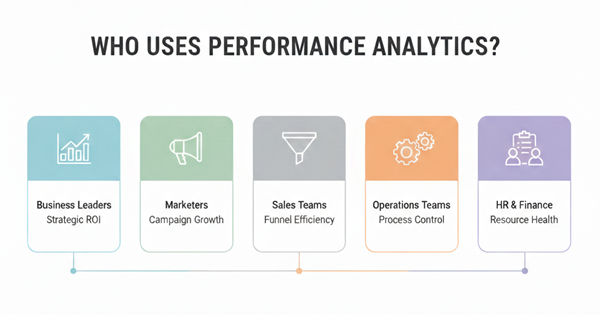
Performance analytics is widely used across different roles and departments:

  • Businesses use it to evaluate overall growth, profitability, operational efficiency, and strategic alignment. 
  • Marketing teams use performance analytics to measure campaign success, conversion rates, return on investment (ROI), and channel effectiveness. 
  • Sales teams rely on it to track funnel performance, lead quality, and revenue outcomes. 
  • Operations and HR teams use performance analytics to assess productivity, efficiency, and workforce performance. 

Across all these use cases, the goal remains the same: measure results, compare them with targets, and take informed action.

Difference Between Analyzing Data and Analyzing Performance

Although closely related, analyzing data and analyzing performance are not the same.

  • Data analysis focuses on examining raw information to find patterns, trends, and insights. 
  • Performance analysis focuses on evaluating outcomes against defined objectives and benchmarks. 

For example, data analysis might show website traffic numbers, while performance analytics determines whether that traffic is contributing to leads, sales, or business growth. Performance analytics adds purpose and direction to data by linking it directly to goals.

3. Scope of Performance Analytics

The scope of performance analytics defines how widely it can be applied within an organization and how deeply it influences decision-making. 

It is not limited to tracking numbers or generating reports. Instead, performance analytics spans day-to-day operations, tactical improvements, and long-term strategic planning, making it a critical function across all business levels.


Operational Scope of Performance Analytics

The operational scope of performance analytics focuses on monitoring and improving daily activities and routine processes. It helps teams understand how efficiently tasks are being executed and whether operational goals are being met.

At the operational level, performance analytics is used to:

  • Track real-time performance metrics 
  • Monitor process efficiency and output 
  • Identify bottlenecks and workflow issues 
  • Ensure consistency in execution 

Operational Scope of Performance Analytics

For example, organizations use performance analytics to monitor system uptime, customer response times, order processing speed, or daily campaign performance. This ensures that operations remain stable, efficient, and aligned with expected standards.


Strategic Scope of Performance Analytics

The strategic scope of performance analytics supports long-term planning and high-level decision-making. It helps leadership evaluate whether organizational strategies are producing the intended outcomes.

At this level, performance analytics is applied to:

  • Measure progress toward business objectives 
  • Evaluate long-term growth trends 
  • Assess return on investment (ROI) 
  • Support policy and strategy adjustments 

Strategic performance analytics allows decision-makers to determine which initiatives should be scaled, optimized, or discontinued based on measurable results rather than assumptions.


Tactical Scope of Performance Analytics

The tactical scope lies between operations and strategy. It focuses on short- to mid-term actions that help improve performance within specific teams, campaigns, or projects.

Performance analytics at the tactical level is used to:

  • Optimize campaigns, processes, or workflows 
  • Compare performance across channels or teams 
  • Test and refine approaches based on results 
  • Support data-backed decision-making 

For instance, marketing teams use tactical performance analytics to adjust ad targeting, refine content strategies, or improve conversion paths based on ongoing performance data.


Performance Analytics Across Short-Term and Long-Term Goals

Performance analytics plays a key role in aligning short-term execution with long-term objectives. In the short term, it helps track immediate outcomes such as daily performance metrics, weekly progress, or campaign results. In the long term, it evaluates sustained growth, efficiency improvements, and goal achievement over time.

By continuously measuring performance at different time intervals, organizations can:

  • Detect early signs of success or failure 
  • Make timely adjustments to avoid long-term losses 
  • Ensure consistency between daily actions and long-term vision 

This balance allows organizations to remain agile while staying focused on long-term success.


Why the Scope of Performance Analytics Keeps Expanding

The scope of performance analytics continues to expand due to digital transformation and the increasing reliance on data-driven systems. As businesses adopt digital tools, automation platforms, and advanced analytics technologies, the volume and variety of measurable performance data grow significantly.

Key reasons for this expansion include:

  • Widespread adoption of digital platforms and cloud systems 
  • Real-time data availability across business functions 
  • Integration of AI and automation in analytics processes 
  • Growing need for accountability, transparency, and measurable outcomes 

As organizations become more digitally connected, performance analytics evolves from a supporting function into a core driver of continuous improvement and competitive advantage.


Overall, the scope of performance analytics extends across operational efficiency, tactical optimization, and strategic decision-making. Its ability to support both immediate actions and long-term goals makes it an essential component of modern, data-driven organizations.

4. Performance Analytics vs Related Concepts

Performance analytics is often confused with other analytics disciplines because they all work with data. However, each serves a distinct purpose

Keeping these comparisons in one place helps clearly define where performance analytics fits and how it differs from related concepts.


4.1 Performance Analytics vs Data Analytics

Relationship and Dependency

Data analytics is the foundation on which performance analytics is built. It involves collecting, processing, and analyzing raw data to identify patterns, trends, and insights. Performance analytics depends on this processed data to evaluate results against predefined goals.

In simple terms, data analytics supplies the information, while performance analytics uses that information to measure success or failure.

Differences in Purpose and Usage

The primary purpose of data analytics is exploration and understanding. It seeks to answer questions such as what happened, why it happened, and what trends exist within the data.

Performance analytics, on the other hand, is goal-oriented. Its purpose is to determine whether actions, strategies, or processes are delivering expected outcomes. While data analytics may reveal traffic growth, performance analytics evaluates whether that growth contributes to conversions, revenue, or efficiency.


4.2 Performance Analytics vs Business Analytics

Business analytics focuses on supporting high-level business decisions by analyzing data related to strategy, finance, operations, and market conditions. It is often used by leadership to guide long-term planning and organizational direction.

Performance analytics is more narrowly focused on measuring how well specific initiatives, teams, or processes are performing. While business analytics helps decide what direction a business should take, performance analytics evaluates how well that direction is being executed.

In essence, business analytics supports strategic decision-making, whereas performance analytics measures execution effectiveness.


4.3 Performance Analytics vs Operational Analytics

Operational analytics concentrates on monitoring day-to-day activities and immediate performance indicators. It provides real-time or near-real-time insights into ongoing operations such as system performance, process efficiency, or daily productivity.

Performance analytics goes beyond daily tracking by assessing overall outcomes against goals and benchmarks. While operational analytics identifies what is happening at the operational level, performance analytics evaluates whether those operations are contributing to broader objectives.

Operational analytics ensures smooth daily functioning, whereas performance analytics ensures that daily efforts lead to meaningful and measurable results.


Summary Comparison

ConceptPrimary FocusPurpose
Data AnalyticsData patterns and trendsUnderstand what and why
Business AnalyticsStrategic decision-makingGuide business direction
Operational AnalyticsDaily activities and processesMonitor real-time operations
Performance AnalyticsOutcomes and goal achievementMeasure effectiveness


By understanding these distinctions, organizations can apply performance analytics more effectively and ensure it complements, rather than overlaps with, other analytics disciplines.

5. Key Components of Performance Analytics

Performance analytics works effectively only when its core components are clearly defined and properly aligned. 

These components ensure that performance is measured accurately, interpreted correctly, and improved continuously. Together, they form a structured framework for evaluating results against goals.


Data Sources

Data sources are the foundation of performance analytics. They provide the raw information needed to measure outcomes and evaluate progress. 

These sources can be internal or external, depending on the area being analyzed.

Common data sources include:

  • Website and application data 
  • Marketing and advertising platforms 
  • Sales and CRM systems 
  • Customer support and feedback tools 
  • Operational and financial systems 

The quality and relevance of data sources directly affect the reliability of performance analytics. Accurate, consistent, and timely data is essential for meaningful performance measurement.


Metrics and KPIs

Metrics are measurable values that track specific activities or results, while Key Performance Indicators (KPIs) are the most important metrics aligned with defined objectives.

In performance analytics:

  • Metrics provide detailed performance signals 
  • KPIs represent critical success indicators 

Effective KPIs are clearly defined, measurable, and directly tied to business goals. Selecting the right KPIs ensures that performance analytics focuses on outcomes that truly matter rather than surface-level numbers.


Benchmarks and Targets

Benchmarks and targets provide context to performance data. Without them, it is difficult to determine whether performance is good, average, or below expectations.

  • Benchmarks compare performance against historical data, industry standards, or competitors 
  • Targets define the desired level of performance within a specific timeframe 

These reference points help organizations assess progress objectively and set realistic expectations for improvement.


Dashboards and Reports

Dashboards and reports are tools used to visualize and communicate performance insights. They transform complex data into clear, understandable formats that support decision-making.

Dashboards typically provide:

  • Real-time or periodic performance snapshots 
  • Visual representations of KPIs and trends 
  • Easy access to critical performance data 

Reports, on the other hand, offer deeper analysis, summaries, and explanations of performance outcomes. Together, dashboards and reports ensure transparency and accessibility across teams and stakeholders.


Feedback Loops for Optimization

Feedback loops enable continuous improvement by connecting performance insights to action. They ensure that findings from performance analytics are not static but lead to meaningful changes.

A strong feedback loop involves:

  • Reviewing performance results 
  • Identifying gaps or improvement areas 
  • Implementing corrective actions 
  • Measuring the impact of those changes 

This iterative process allows organizations to adapt quickly, refine strategies, and improve performance over time.


Data sources, metrics, benchmarks, dashboards, and feedback loops work together to create a complete performance analytics system. When these components are aligned, performance analytics becomes a powerful tool for measuring effectiveness and driving continuous improvement.

6. Performance Metrics and KPIs Explained

Performance metrics and KPIs are the backbone of performance analytics. They define what is measured, how success is evaluated, and where improvements are needed. 

Choosing the right metrics ensures that performance analytics delivers meaningful insights rather than misleading numbers.


What Makes a Good Performance Metric

A good performance metric clearly reflects progress toward a specific objective. It should provide accurate, actionable, and relevant information that supports decision-making.

Effective performance metrics are:

  • Goal-aligned – directly connected to defined objectives 
  • Measurable – based on clear and reliable data 
  • Actionable – capable of driving improvement actions 
  • Consistent – measured the same way over time 
  • Easy to understand – accessible to all stakeholders 

Metrics that lack clarity or relevance often create confusion and lead to poor decisions.


Leading vs Lagging Indicators

Performance metrics can be classified as leading or lagging indicators based on what they measure.

  • Leading indicators predict future performance. They signal whether current actions are likely to produce desired outcomes.
    Examples include engagement rates, lead quality scores, or process completion rates. 
  • Lagging indicators measure results after outcomes have occurred. They confirm whether goals have been achieved.
    Examples include revenue, profit margins, customer retention, or conversion rates. 

A strong performance analytics framework uses both types. Leading indicators help guide proactive action, while lagging indicators validate results.


Quantitative vs Qualitative KPIs

KPIs can also be categorized based on the type of data they use.

  • Quantitative KPIs are numeric and measurable. They focus on measurable outputs such as sales volume, response time, or error rates. 
  • Qualitative KPIs capture perceptions, experiences, or quality-based outcomes. These include customer satisfaction, feedback sentiment, or service quality assessments. 

Combining quantitative and qualitative KPIs provides a more complete view of performance, balancing measurable results with user or customer experience.


Common KPI Mistakes to Avoid

Despite their importance, KPIs are often misused. Common mistakes reduce the effectiveness of performance analytics and lead to poor insights.

Some common KPI pitfalls include:

  • Tracking too many KPIs at once 
  • Using metrics that are not linked to goals 
  • Focusing on vanity metrics instead of meaningful outcomes 
  • Ignoring context such as benchmarks or timeframes 
  • Failing to review and update KPIs regularly 

Avoiding these mistakes ensures that KPIs remain relevant, focused, and aligned with performance objectives.


Well-defined performance metrics and KPIs provide clarity, direction, and accountability. When chosen correctly, they transform performance analytics into a practical tool for evaluating success and driving continuous improvement.

7. Performance Analytics Process (Step-by-Step)

The performance analytics process follows a structured flow that turns raw data into measurable outcomes and continuous improvement. 

Each step builds on the previous one, ensuring that insights are accurate, actionable, and aligned with defined goals.


Goal Setting and Performance Objectives

The process begins with clear goal setting. Performance analytics is only effective when objectives are well defined and measurable.

At this stage, organizations:

  • Define what success looks like 
  • Align goals with business or team objectives 
  • Identify outcomes that need to be measured 
  • Set timeframes for evaluation 

Clear performance objectives ensure that analytics efforts remain focused and relevant.


Data Collection

Once goals are established, the next step is data collection. This involves gathering relevant data from appropriate sources that reflect performance outcomes.

Data collection may include:

  • System and platform data 
  • Campaign or process data 
  • Customer interaction data 
  • Operational and financial data 

Collecting the right data is critical, as irrelevant or incomplete data can lead to inaccurate performance evaluation.


Data Validation and Accuracy Checks

Before analysis begins, data must be verified for accuracy and reliability. Data validation ensures that performance insights are based on trustworthy information.

This step includes:

  • Checking data completeness 
  • Identifying inconsistencies or errors 
  • Removing duplicates 
  • Ensuring data aligns with defined metrics 

Accurate data prevents misleading conclusions and strengthens confidence in performance analytics.


Performance Measurement

In this step, collected data is measured against predefined metrics, KPIs, benchmarks, and targets.

Performance measurement focuses on:

  • Comparing actual results with expected outcomes 
  • Identifying performance gaps 
  • Tracking progress over time 

This step provides a clear picture of whether goals are being met or missed.


Insight Generation

Insight generation transforms measured results into meaningful understanding. Instead of just reporting numbers, performance analytics identifies patterns, trends, and root causes.

Insights help answer:

  • Why performance improved or declined 
  • Which factors influenced results 
  • What changes are needed 

This step bridges the gap between measurement and decision-making.


Action and Optimization

Insights become valuable only when they lead to action. In this stage, organizations use performance findings to improve processes, strategies, or execution.

Typical actions include:

  • Refining strategies or workflows 
  • Adjusting resource allocation 
  • Improving targeting or efficiency 
  • Eliminating underperforming elements 

Optimization ensures that performance analytics directly contributes to better outcomes.


Continuous Monitoring

Performance analytics is not a one-time activity. Continuous monitoring ensures that performance remains aligned with goals over time.

This step involves:

  • Regular performance tracking 
  • Ongoing KPI reviews 
  • Early detection of performance issues 
  • Continuous improvement cycles 

By continuously monitoring performance, organizations stay agile and responsive to change.


The performance analytics process follows a logical and repeatable cycle—from goal setting to continuous monitoring. This structured approach ensures accurate measurement, informed decisions, and sustained performance improvement.

8. Types of Performance Analytics

Performance analytics can be categorized into distinct types based on the depth of analysis and the questions they answer. 

Each type plays a unique role in understanding, explaining, and improving performance. Together, they form a complete performance analytics framework.


Descriptive Performance Analytics

Descriptive performance analytics focuses on summarizing past performance. It explains what happened by organizing and presenting historical data in a clear and understandable format.

This type of analytics is used to:

  • Track completed performance outcomes 
  • Identify trends over time 
  • Create performance reports and dashboards 
  • Establish performance baselines 

Descriptive performance analytics provides visibility into results but does not explain causes or suggest future actions.


Diagnostic Performance Analytics

Diagnostic performance analytics goes a step further by explaining why performance outcomes occurred. It identifies the factors and conditions that influenced results.

It is used to:

  • Analyze performance gaps 
  • Identify root causes of success or failure 
  • Compare performance across variables 
  • Understand relationships between metrics 

Diagnostic analytics helps organizations move from observation to understanding.


Predictive Performance Analytics

Predictive performance analytics focuses on forecasting future performance based on historical data and current trends. It answers the question what is likely to happen next.

This type is used to:

  • Anticipate performance trends 
  • Estimate future outcomes 
  • Identify potential risks and opportunities 
  • Support proactive decision-making 

Predictive performance analytics enables organizations to prepare for future scenarios rather than reacting after results occur.


Prescriptive Performance Analytics

Prescriptive performance analytics provides recommendations on what actions should be taken to achieve desired performance outcomes. It combines insights from descriptive, diagnostic, and predictive analytics.

It is used to:

  • Suggest optimal actions 
  • Evaluate multiple decision scenarios 
  • Optimize performance strategies 
  • Improve efficiency and outcomes 

Prescriptive analytics turns performance insights into clear guidance for decision-making.


Summary of Performance Analytics Types

TypeKey Question AnsweredPurpose
DescriptiveWhat happened?Understand past performance
DiagnosticWhy did it happen?Identify causes
PredictiveWhat may happen next?Forecast outcomes
PrescriptiveWhat should be done?Recommend actions


Each type of performance analytics serves a specific purpose. When used together, they provide a comprehensive approach to measuring performance, understanding outcomes, anticipating future results, and driving continuous improvement.

9. Use Cases of Performance Analytics Across Industries

9.1 Performance Analytics in Digital Marketing

Digital marketing is one of the most practical and widely adopted use cases of performance analytics. 

Since every digital activity generates measurable data, performance analytics helps marketers evaluate results accurately, optimize campaigns, and justify marketing spend with clear outcomes.


Campaign Performance

Performance analytics is used to measure how individual marketing campaigns perform against predefined goals. This includes tracking whether a campaign delivers the expected reach, engagement, and conversions within a specific timeframe.

Through campaign performance analysis, marketers can:

  • Identify high-performing and underperforming campaigns 
  • Compare results across different campaign types 
  • Measure goal completion rates 
  • Understand performance trends over time 

This ensures that marketing decisions are driven by results rather than assumptions.


Channel Performance

Digital marketing relies on multiple channels such as search engines, social media, email, and paid advertising platforms. Performance analytics helps evaluate how each channel contributes to overall marketing success.

Channel performance analysis focuses on:

  • Comparing traffic and engagement across channels 
  • Identifying the most effective acquisition sources 
  • Understanding channel-specific strengths and weaknesses 
  • Optimizing budget allocation 

By measuring channel performance, marketers can prioritize channels that deliver consistent and meaningful results.


Conversion Tracking

Conversion tracking is a core use case of performance analytics in digital marketing. It measures whether user actions align with business objectives.

Performance analytics enables marketers to:

  • Track desired actions such as sign-ups, purchases, or inquiries 
  • Analyze conversion paths and user behavior 
  • Identify drop-off points in funnels 
  • Improve conversion rates through optimization 

This helps ensure that traffic and engagement translate into real business outcomes.


ROI Measurement

Return on investment (ROI) measurement is one of the most critical applications of performance analytics in digital marketing. It evaluates whether marketing efforts generate value relative to cost.

Using performance analytics, marketers can:

  • Measure revenue generated from campaigns 
  • Compare marketing spend with outcomes 
  • Identify cost-effective strategies 
  • Improve marketing efficiency 

ROI measurement ensures accountability and supports data-driven budgeting and strategic planning.


Overall, performance analytics enables digital marketing teams to move beyond surface-level metrics and focus on measurable impact. 

By analyzing campaign results, channel effectiveness, conversions, and ROI, organizations can continuously improve marketing performance and achieve sustainable growth.


9.2 Performance Analytics in Sales

Performance analytics plays a crucial role in sales by helping organizations measure how effectively their sales efforts convert opportunities into revenue. 

Instead of relying on intuition or isolated numbers, sales teams use performance analytics to evaluate outcomes, identify gaps, and improve overall sales efficiency.


Sales Funnel Performance

Sales funnel performance analysis focuses on understanding how prospects move through each stage of the sales journey, from initial contact to final purchase.

Using performance analytics, sales teams can:

  • Track movement across funnel stages 
  • Identify where leads drop off 
  • Measure stage-wise conversion rates 
  • Detect bottlenecks slowing down deal closures 

This insight helps organizations refine their sales process and improve lead progression through the funnel.


Revenue Tracking

Revenue tracking is a core application of performance analytics in sales. It evaluates how much revenue is generated over a specific period and how it aligns with targets.

Performance analytics enables sales teams to:

  • Monitor revenue growth trends 
  • Compare actual revenue with forecasts 
  • Analyze revenue by product, region, or team 
  • Measure performance against sales targets 

Accurate revenue tracking supports better forecasting, budgeting, and strategic planning.


Conversion Efficiency

Conversion efficiency measures how effectively sales activities turn leads into paying customers. Performance analytics helps identify which strategies, channels, or sales actions produce the best results.

Through conversion efficiency analysis, teams can:

  • Measure lead-to-customer conversion rates 
  • Identify high-performing sales approaches 
  • Reduce wasted effort on low-quality leads 
  • Improve overall sales productivity 

By focusing on conversion efficiency, sales teams can achieve better results without increasing resources or costs.


Overall, performance analytics in sales provides clarity, accountability, and direction. By analyzing funnel performance, tracking revenue, and improving conversion efficiency, organizations can optimize sales outcomes and drive sustainable growth.


9.3 Performance Analytics in Operations

In operations, performance analytics is used to ensure that processes run efficiently, resources are used effectively, and costs remain under control. 

It provides visibility into how operational activities perform on a day-to-day basis while also supporting long-term improvement initiatives.


Process Efficiency

Process efficiency analysis focuses on how smoothly and consistently operational workflows function. 

Performance analytics helps measure whether processes deliver expected outputs within defined time, quality, and cost parameters.

Using performance analytics, operations teams can:

  • Track process completion times 
  • Identify delays and bottlenecks 
  • Measure error rates and rework levels 
  • Compare actual performance with process standards 

Improving process efficiency leads to faster delivery, better quality, and improved operational reliability.


Resource Utilization

Resource utilization measures how effectively an organization uses its available resources, including manpower, equipment, systems, and time.

Performance analytics supports resource utilization by:

  • Monitoring workload distribution 
  • Identifying underutilized or overutilized resources 
  • Aligning resources with operational demand 
  • Improving scheduling and capacity planning 

Optimized resource utilization reduces waste and ensures that operational capacity is used productively.


Cost Optimization

Cost optimization focuses on reducing unnecessary expenses while maintaining or improving performance. Performance analytics provides data-driven insight into where costs originate and how they relate to operational outcomes.

Through cost optimization analysis, organizations can:

  • Track operational costs by process or function 
  • Identify cost inefficiencies 
  • Evaluate cost-to-performance relationships 
  • Support smarter budgeting decisions 

By linking costs directly to performance, organizations can optimize spending without compromising efficiency or quality.


In operations, performance analytics connects efficiency, resource usage, and cost control into a unified framework. This enables organizations to run leaner operations, respond quickly to issues, and continuously improve operational performance.


9.4 Performance Analytics in HR

In human resources, performance analytics helps organizations evaluate workforce effectiveness, improve productivity, and retain talent. 

By using measurable insights rather than subjective judgment, HR teams can make fair, informed, and data-backed decisions.


Employee Performance

Employee performance analysis focuses on measuring how well individuals and teams meet defined roles and expectations. Performance analytics provides objective insight into outcomes, consistency, and contribution.

HR teams use performance analytics to:

  • Track goal completion and output quality 
  • Evaluate performance trends over time 
  • Identify high performers and skill gaps 
  • Support performance reviews and development plans 

This approach ensures performance evaluations are structured, transparent, and aligned with organizational objectives.


Productivity Analysis

Productivity analysis measures how efficiently employees convert time and effort into results. Performance analytics helps identify factors that influence productivity across roles and departments.

Through productivity analysis, HR teams can:

  • Measure output per employee or team 
  • Identify workflow or workload imbalances 
  • Assess the impact of tools and processes on productivity 
  • Support better workforce planning 

Improved productivity analysis helps organizations enhance efficiency without increasing employee burnout.


Retention Metrics

Retention metrics focus on understanding employee stability and long-term engagement. Performance analytics helps HR teams identify patterns that influence employee retention and turnover.

Key uses include:

  • Tracking employee turnover rates 
  • Measuring retention across departments or roles 
  • Identifying factors linked to attrition 
  • Evaluating the effectiveness of retention initiatives 

By analyzing retention metrics, organizations can improve employee satisfaction, reduce hiring costs, and maintain workforce continuity.


Overall, performance analytics in HR supports better people management by linking employee performance, productivity, and retention to measurable outcomes. This enables HR teams to create a more engaged, efficient, and stable workforce.


9.5 Performance Analytics in Finance

In finance, performance analytics helps organizations maintain financial stability, control costs, and plan for future growth. 

By measuring financial outcomes against targets, finance teams can ensure accountability, accuracy, and better decision-making.


Financial Performance Tracking

Financial performance tracking focuses on monitoring an organization’s financial health over time. Performance analytics provides visibility into whether financial objectives are being met.

Finance teams use performance analytics to:

  • Track revenue, expenses, and profit margins 
  • Monitor cash flow and liquidity 
  • Compare actual performance with financial targets 
  • Identify trends affecting financial stability 

This enables organizations to quickly detect financial risks and opportunities.


Budget Efficiency

Budget efficiency analysis evaluates how effectively financial resources are allocated and utilized. Performance analytics helps determine whether spending delivers the expected value.

Using budget efficiency metrics, finance teams can:

  • Compare planned budgets with actual spending 
  • Identify areas of overspending or underutilization 
  • Evaluate cost-to-outcome relationships 
  • Improve resource allocation decisions 

Improved budget efficiency ensures that financial resources support high-impact activities without unnecessary waste.


Forecast Accuracy

Forecast accuracy measures how closely financial predictions align with actual outcomes. Performance analytics helps finance teams evaluate and refine forecasting models.

Key applications include:

  • Comparing forecasts with real financial results 
  • Identifying factors causing forecast deviations 
  • Improving planning and financial modeling 
  • Supporting data-driven strategic decisions 

High forecast accuracy strengthens financial planning, risk management, and long-term business strategy.


Overall, performance analytics in finance links financial tracking, budget control, and forecasting into a cohesive system. This allows organizations to maintain financial discipline while supporting sustainable growth and informed decision-making.


10. Performance Analytics Tools and Technologies

Performance analytics relies on a combination of tools and technologies that collect data, measure outcomes, and present insights in a usable format. 

These tools help organizations move from manual reporting to real-time, insight-driven performance management.


Performance Dashboards

Performance dashboards provide a centralized view of key metrics and KPIs. They present performance data visually, making it easier to monitor progress and identify trends at a glance.

Dashboards are used to:

  • Track KPIs in real time or at regular intervals 
  • Compare performance across teams, processes, or time periods 
  • Highlight performance gaps and anomalies 
  • Support faster decision-making 

Well-designed dashboards ensure clarity and reduce the need for manual data interpretation.

Reporting Tools

Reporting tools focus on structured analysis and documentation of performance results. Unlike dashboards, reports often provide deeper context, explanations, and historical comparisons.

Reporting tools help organizations:

  • Generate periodic performance summaries 
  • Analyze trends and outcomes over time 
  • Share performance insights with stakeholders 
  • Support audits and compliance needs 

Reports play a critical role in accountability and long-term performance evaluation.


Automation and Monitoring Systems

Automation and monitoring systems reduce manual effort by continuously tracking performance metrics and triggering alerts when thresholds are crossed.

These systems are used to:

  • Monitor performance in real time 
  • Automate data collection and reporting 
  • Detect performance issues early 
  • Enable faster response to deviations 

Automation ensures consistency and improves the speed and accuracy of performance analytics.


Role of AI and Machine Learning

Artificial intelligence (AI) and machine learning enhance performance analytics by enabling advanced analysis and predictive capabilities.

Their role includes:

  • Identifying hidden performance patterns 
  • Predicting future performance outcomes 
  • Recommending optimization actions 
  • Supporting adaptive and self-learning analytics models 

AI-driven performance analytics allows organizations to move beyond descriptive insights toward proactive and prescriptive decision-making.


Integration with Existing Business Systems

Effective performance analytics depends on seamless integration with existing business systems such as CRM, ERP, marketing platforms, and financial tools.

System integration enables:

  • Unified performance measurement across functions 
  • Consistent data flow between platforms 
  • Reduced data silos 
  • More accurate and comprehensive insights 

When performance analytics tools integrate smoothly with business systems, organizations gain a complete and reliable view of performance across the enterprise.


Performance analytics tools and technologies work together to collect, analyze, visualize, and optimize performance. From dashboards and reports to AI-driven automation and system integration, these technologies form the backbone of modern performance analytics.


0 0 votes
Article Rating
Subscribe
Notify of
guest
0 Comments
Oldest
Newest Most Voted
Inline Feedbacks
View all comments