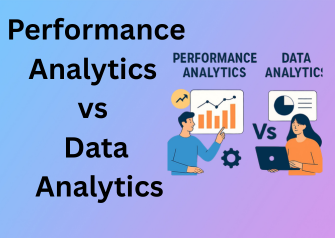
Most businesses are sitting on more data than ever. Website traffic, sales numbers, campaign results, customer behaviour , it is all being tracked. But here is the problem: having data and knowing whether your business is actually performing are two very different things.
That gap is exactly where the confusion between performance analytics and data analytics starts.
Both terms get thrown around a lot, often as if they mean the same thing. They do not. And mixing them up can lead to measuring the wrong things, drawing the wrong conclusions, and making decisions that do not actually move the needle.
In this article, you will learn what each term really means, where they differ, and which one your business needs depending on what you are trying to achieve. No jargon, no fluff just a clear explanation that helps you use both more effectively.
What Is Data Analytics?
Data analytics is the process of examining raw data to find patterns, trends, and relationships. At its core, it answers one straightforward question: What does the data show?
It is a broad discipline. You do not need a predefined goal to get value from it. You start with data, explore what is in it, and let the findings emerge. That is what makes it so widely used it works for almost any question that involves numbers and information.
A simple example: a retail store analyzes its sales data from the past two years and discovers that customers buy more winter clothing in October than in December. That finding came from exploring the data, not from having a target in mind first. That is data analytics doing exactly what it is designed to do.
In practice, data analytics covers four main approaches. Descriptive analytics summarizes what happened. Diagnostic analytics explains why it happened. Predictive analytics forecasts what is likely to happen next. Prescriptive analytics recommends what action to take. Together, these four form the full scope of what data analytics can do.
Data analytics is primarily used by data analysts, data scientists, and technical teams. These are the people who work directly with raw data cleaning it, modeling it, and turning it into findings that others can act on.
What Is Performance Analytics?

Performance analytics is the practice of measuring outcomes against predefined goals using metrics and Key Performance Indicators (KPIs). The core question it answers is: “Is what we are doing working as intended?”
Unlike data analytics, it does not start with raw data and see what turns up. It starts with a goal and works backward measuring whether actions, strategies, and processes are actually delivering the results they were supposed to.
That makes performance analytics goal-driven and execution-focused. Every metric it tracks is connected to a target or benchmark. Without that connection, there is no way to judge whether performance is good, average, or falling short.
Let’s go back to the same retailer. Data analytics revealed that customers buy more winter clothing in October. Now performance analytics steps in and asks the harder question: did October sales actually hit the revenue target? If they fell short by 20 percent, what caused that gap , was it pricing, low stock, poor promotion, or something else? That is the layer performance analytics adds. It does not just describe what happened. It evaluates whether what happened was good enough.
Performance analytics is used across almost every business function. Marketing managers use it to measure campaign ROI. Sales leaders use it to track pipeline and revenue targets. Operations directors use it to monitor process efficiency. HR teams use it to evaluate workforce productivity. Finance teams use it to track budget accuracy and cost control.
For a deeper look at how performance analytics works end to end, visit our full guide on performance analytics.
Performance Analytics vs Data Analytics – The Core Difference
Data analytics tells you what is happening. Performance analytics tells you whether what is happening is good enough.
That one line captures the entire difference. But it helps to understand why they feel so similar in the first place.
Both work with data. Both produce insights. Both are used to make better decisions. So it is easy to assume they are just two names for the same thing. They are not. The difference is not really about the data itself , it is about the intent behind the analysis.
Data analytics is about exploration. You are trying to understand what the data contains. You are looking for patterns, trends, and relationships that explain what is going on. There is no pass or fail. There is no target being missed or hit. You are simply trying to see clearly.
Performance analytics is about evaluation. You already have a goal. Now you are measuring whether reality is matching up to it. Every number you look at is being held up against a benchmark, a target, or an expected outcome. The question is never just what happened , it is always “was that good enough, and if not, what needs to change?”
The important thing to understand is that performance analytics does not replace data analytics. It builds on top of it. You cannot evaluate performance without first having clean, reliable data to work with. Data analytics lays the foundation. Performance analytics gives that foundation a direction.
Think of it this way. Data analytics is the engine , it powers everything. Performance analytics is the steering wheel , it decides where all that power is actually going. An engine without a steering wheel gets you nowhere useful. A steering wheel without an engine does nothing at all. You need both, working together.
Key Differences Between Performance Analytics and Data Analytics
Now that we know what each one means, let us put them side by side. The table below gives you a quick snapshot of how they compare across the dimensions that matter most.
| Dimension | Data Analytics | Performance Analytics |
| Core Question | What does the data show? | Are we hitting our targets? |
| Starting Point | Raw data | Defined goals and KPIs |
| Output | Patterns and observations | Performance gaps and action priorities |
| Context Needed | Optional | Essential (benchmarks, targets) |
| Primary Goal | Understand data | Improve outcomes |
| Used By | Data teams | Business and operational teams |
| Time Focus | Past and present | Past, present, and future |
| Relationship to Goals | Not required | Always required |
The table tells the story at a glance. But each of these differences is worth understanding a little deeper because they change how you actually use each discipline in practice.
1. Goals Come First in Performance Analytics
With data analytics, you can start without a goal and still get something useful out of it. You open the data, explore what is there, and see what surfaces. The findings guide the direction.
Performance analytics works the opposite way. The goal comes first , always. Without a defined target, there is nothing to measure performance against. You would just be staring at numbers with no way to judge whether they are good or bad.
A practical way to check which one you are doing: if your team is analysing data without a clear target in mind, that is data analytics. The moment you ask “are we hitting our goal?” you have crossed into performance analytics.
2. Metrics vs KPIs – Not All Numbers Are Equal
Data analytics works with any metric that helps explain what is happening in the data. A data analyst might track dozens of different numbers to build a complete picture.
Performance analytics is more selective. It focuses on KPIs , Key Performance Indicators , which are the specific metrics directly tied to a business objective. Not every metric qualifies. Only the ones that tell you whether a goal is being met.
Here is a clear example of the difference. Page views is a metric. It tells you something happened. Conversion rate tied to a revenue goal is a KPI. It tells you whether what happened actually matters to the business. Performance analytics cares about the second type, not the first.
3. Context Is What Turns a Number Into a Verdict
Data analytics can hand you a result and leave it there. For example: your campaign generated 8,000 clicks last month. That is a finding.
Performance analytics immediately asks the next question. Was 8,000 clicks above or below the target? Is that better or worse than last month? What does it mean for the revenue goal this quarter?
Benchmarks and targets are what give a number meaning. Without them, data is interesting at best. With them, it becomes something you can actually act on. That context is optional in data analytics and non-negotiable in performance analytics.
4. What You Walk Away With
When data analytics is done well, you walk away with insights and observations. You understand the landscape better. You know what is happening and have some idea of why.
When performance analytics is done well, you walk away with priorities. You know what is working, what is not, how big the gap is, and where to focus your energy next. That is why performance analytics is more directly connected to decisions about budgets, strategy, and resource allocation. It does not just inform , it directs.
5. Who Actually Reads the Output
Data analytics outputs are mostly read by technical teams , analysts, data scientists, and engineers who understand how to interpret raw findings and complex visualisations.
Performance analytics outputs are built for business decision-makers. Executives, department heads, team leads , people who need clear answers to business questions, not raw data to interpret themselves. This is why performance analytics typically uses dashboards, KPI scorecards, and summary reports rather than detailed data models. The goal is clarity, not depth.
Where They Overlap (And Why That Matters)
It would be easy to read everything above and think performance analytics and data analytics are on opposite sides of the fence. They are not. In fact, they are two parts of the same process , and trying to use one without the other creates real problems.
Performance analytics cannot function without data analytics. Before you can measure whether you are hitting a target, you need clean, reliable, well-analyzed data to measure with. If the data is messy, incomplete, or misread, your performance conclusions will be wrong no matter how well-defined your goals are. Data analytics is what makes the numbers trustworthy in the first place.
At the same time, data analytics on its own has a ceiling. You can explore data endlessly and produce fascinating findings , but if none of it is connected to a goal, it rarely changes anything. It stays in a report that gets read once and forgotten.
That is why the most effective organisations do not choose between the two. They run them together as a continuous cycle.
It works like this. Data analytics surfaces patterns and trends in the data. Performance analytics picks those up and evaluates them against business goals. That evaluation leads to decisions , a strategy gets adjusted, a budget gets reallocated, a process gets fixed. Those decisions create new activity, which generates new data. And the cycle starts again.
Each loop makes the organisation a little sharper. A little faster at spotting problems. A little better at turning insight into action.
There is a phrase that captures this well: "Analytics without a performance goal is just exploration. Performance without analytics is just guesswork." Neither half is enough on its own. Together, they are what actually moves a business forward.
A Side-by-Side Example – Same Data, Different Approach
Sometimes the clearest way to understand a concept is to see it in action. So let us take one real scenario and run it through both approaches using the exact same data.
The scenario: A digital marketing team just finished a month-long lead generation campaign. The data is in. Now what?
The Data Analytics Approach
The analyst pulls all available campaign data , impressions, clicks, bounce rate, time on page, device type, and channel breakdown. The goal is to understand what happened and how users behaved throughout the campaign.
Here is what they find. Mobile users clicked on ads at a higher rate than desktop users, but they also bounced significantly faster once they landed on the page. Email drove lower click volume than paid social, but the engagement was deeper , people spent more time reading and were more likely to take a second action.
The output is a detailed breakdown of user behaviour across the campaign. It is genuinely useful. The team now understands their audience better than they did before.
But there is one thing this approach does not tell them: was the campaign actually successful?
The Performance Analytics Approach
The performance analyst starts in a completely different place. Before looking at a single number, they go back to the original goal: 500 qualified leads at a cost of no more than $20 per lead.
Now they measure what actually happened. The campaign generated 340 leads at $29 per lead.
That means the team landed 32 percent below the lead target and ran 45 percent over the cost target. Both gaps are significant. Performance analytics does not stop at flagging the gap , it digs into the cause.
The data shows that mobile traffic made up 61 percent of all clicks but accounted for only 19 percent of conversions. The mobile landing page was slow to load and the form was difficult to complete on a small screen. That is where the leads were being lost.
The recommendation is clear: fix the mobile landing page experience and shift a portion of the paid social budget toward email, which was delivering better quality engagement at a lower cost.
Both approaches used the exact same campaign data. The numbers were identical. But the data analytics approach asked “what happened?” and the performance analytics approach asked “did it work, and what do we do about it?”
That difference in starting question is what separates an interesting report from a decision that actually improves results.
When Should You Use Each?
Knowing the difference between these two disciplines is useful. Knowing when to apply each one is what actually changes how your team works. Here is a straightforward guide.
Use Data Analytics When
You are exploring a new dataset for the first time. If you have just started collecting data from a new source , a new platform, a new market, a new product , data analytics is the right starting point. You need to understand what you are working with before you can measure anything meaningfully.
You need to understand what is in your data before setting targets. Setting performance targets without understanding your data first is like setting a speed limit on a road you have never driven. Data analytics helps you establish baselines, spot irregularities, and understand what normal looks like – so the targets you eventually set are grounded in reality.
You are building the infrastructure for a performance measurement system. Before you can track KPIs consistently, someone has to build the data pipelines, clean the inputs, and validate that the right information is being captured. That work is data analytics. It is the preparation phase that makes performance analytics possible.
Data quality is unknown and needs to be assessed first. If you are not confident that your data is accurate and complete, running performance analysis on top of it will produce misleading conclusions. Data analytics first , performance analytics once the foundation is solid.
Use Performance Analytics When
You have defined business goals and need to measure progress toward them. This is the most common trigger. Once your goals are clear , a revenue target, a conversion rate, a cost threshold , performance analytics is what tells you whether you are on track and where you are falling short.
You are preparing performance reviews or strategic reports. Whether it is a monthly marketing report, a quarterly business review, or an annual strategy session, performance analytics is what gives those conversations substance. It connects results to objectives and makes the discussion about outcomes, not just activity.
You want to identify where to focus improvement efforts. When resources are limited , and they always are , performance analytics helps you see which gaps are biggest, which areas are underperforming the most, and where fixing something will have the greatest impact.
You need to predict whether current trends will hit future targets. Performance analytics is not only backward-looking. It uses current trajectory data to forecast whether you are on course to meet upcoming targets , giving you time to adjust before it is too late.
Use Both When
You want to build a continuous improvement loop. The most effective teams do not choose between the two. They use data analytics to stay informed and performance analytics to stay accountable. Together they create a cycle where data leads to insight, insight leads to action, and action generates new data to learn from.
You are scaling a business function. When a team or department is growing – adding new channels, entering new markets, expanding headcount — you need data analytics to explore what is new and performance analytics to ensure the growth is delivering results. Scaling without both is how organisations grow busy without growing effective.
Frequently Asked Questions
Is performance analytics the same as data analytics?
No. They are related but they serve different purposes. Data analytics focuses on examining raw data to find patterns, trends, and relationships. Performance analytics takes it a step further , it evaluates whether those patterns are actually contributing to defined business goals and targets. One tells you what is happening. The other tells you whether what is happening is good enough.
Can you do performance analytics without data analytics?
Not effectively. Data analytics is the foundation that performance analytics is built on. Before you can measure whether performance is meeting expectations, you need clean, accurate, and well-analyzed data to measure with. Skipping data analytics and jumping straight to performance conclusions is like judging a race result without a working stopwatch. The infrastructure has to be right first.
What is the main goal of performance analytics?
The main goal is to evaluate whether a business, team, process, or strategy is achieving its defined objectives. It is not enough to know that something happened , performance analytics asks whether what happened was good enough, how far it fell short if not, and what needs to change to close that gap. Improvement is always the end destination.
What is the difference between performance metrics and data metrics?
Data metrics are any measurable values that track activity or outcomes , clicks, visits, transactions, open rates. There are potentially hundreds of them in any dataset. Performance metrics, or KPIs, are a specific and smaller subset. They are the metrics directly tied to a defined business goal and used to judge success or failure. Every KPI is a metric. But not every metric is a KPI. The difference is whether the number is connected to an objective that actually matters to the business.
Which is more useful for business decision-making?
For day-to-day business decisions, performance analytics is more directly useful because it connects data to outcomes and produces clear action priorities. Data analytics provides the understanding that makes those decisions reliable. Neither is more important in an absolute sense , but if you need to decide where to invest, what to fix, or whether a strategy is working, performance analytics gives you the answer. Data analytics gives you the evidence behind it.
Conclusion
The difference between performance analytics and data analytics comes down to one thing: the question you start with.
Data analytics starts with the data and asks what it shows. Performance analytics starts with a goal and asks whether results are measuring up. Both matter. Both serve a real purpose. But they are not interchangeable, and using one when you need the other will leave you with either findings you cannot act on or conclusions you cannot trust.
The businesses that consistently improve are the ones that use both together. They use data analytics to stay informed and performance analytics to stay accountable. That combination is what turns raw numbers into decisions and decisions into measurable progress.
If your team is collecting data but struggling to connect it to outcomes, the missing piece is likely performance analytics , not more data.
Want to go deeper? Read our complete guide to performance analytics and learn how to build a system that turns every metric into meaningful results.