Online privacy has become a major concern for individuals and businesses alike. Traditional cloud storage platforms often require personal information, track user activity, and store metadata that can reveal details about how files are accessed and shared. As concerns about data collection continue to grow, many users are searching for privacy-focused alternatives that offer greater control over their digital information.
One name that has gained attention in privacy discussions is Anon Vault. It is commonly described as a secure cloud storage solution designed to protect user anonymity through encryption, private file management, and reduced data collection practices. Many users discover Anon Vault while searching for anonymous file storage, secure cloud backups, encrypted document sharing, or alternatives to mainstream services such as Google Drive and Dropbox.
However, information about Anon Vault can be confusing. Different websites describe it in different ways, and there are questions about how it works, how secure it is, whether it is trustworthy, and how it compares with established privacy-focused storage providers.
This guide provides a detailed look at Anon Vault, including its features, security architecture, privacy protections, benefits, limitations, potential risks, and alternatives. You will also learn whether Anon Vault is a suitable option for your storage needs and what factors to consider before trusting any anonymous cloud storage platform.
What Is Anon Vault?
Anon Vault is commonly described as a privacy-focused cloud storage platform that emphasizes anonymous file storage, strong encryption, and user data protection. Unlike traditional cloud storage services that often require personal information and collect user activity data, Anon Vault is associated with privacy-first principles designed to give users greater control over their digital files.
The platform is frequently discussed in relation to end-to-end encryption, zero-knowledge security, and decentralized storage concepts. These technologies aim to reduce unauthorized access to stored data while limiting the amount of information that service providers can view or collect.
Users typically explore Anon Vault when looking for secure file storage, private document sharing, encrypted backups, or alternatives to mainstream cloud storage providers.
Key Takeaways
- Anon Vault is presented as an anonymous cloud storage solution focused on privacy and security.
- It uses encryption technologies to help protect files from unauthorized access.
- Many sources associate Anon Vault with an end-to-end encryption model.
- A zero-knowledge approach means storage providers may not have access to user files or encryption keys.
- Decentralized storage concepts can help reduce reliance on a single storage server.
- It is often considered by users seeking greater privacy than traditional cloud storage platforms.
- Security, transparency, and long-term trustworthiness should be evaluated before storing sensitive information.
At a Glance
| Feature | Anon Vault |
|---|---|
| Primary Purpose | Private Cloud Storage |
| Privacy Focus | High |
| End-to-End Encryption | Commonly Reported |
| Zero-Knowledge Storage | Often Associated |
| Anonymous Access Options | Available in Some Implementations |
| Decentralized Storage Concepts | Frequently Mentioned |
| File Sharing | Supported |
| Intended Users | Privacy-Conscious Individuals and Organizations |
While Anon Vault is often promoted as a secure and anonymous storage solution, understanding how its privacy claims, encryption methods, and storage architecture work in practice is essential before deciding whether it is the right choice for your data.
Definition
Anon Vault is commonly described as an anonymous cloud storage platform that focuses on protecting user data through encryption and privacy-centered security measures. Unlike conventional storage services that may collect account information and usage data, Anon Vault is often presented as a solution that prioritizes confidentiality and user control.
The platform is typically linked to concepts such as:
- End-to-end encryption
- Zero-knowledge storage
- Anonymous file management
- Secure file sharing
- Privacy-focused cloud infrastructure
These features are intended to help users maintain greater control over who can access their files and personal information.
Purpose
The primary purpose of Anon Vault is to provide a secure environment for storing digital files while reducing privacy risks commonly associated with traditional cloud services.
Users may choose Anon Vault to:
- Store sensitive documents securely
- Protect personal and business files
- Share files privately
- Reduce data tracking and monitoring
- Maintain greater anonymity online
- Create encrypted backups of important information
The platform aims to address growing concerns about surveillance, data breaches, unauthorized access, and excessive data collection practices.
How It Differs From Traditional Cloud Storage
Traditional cloud storage services focus on convenience, collaboration, and integration with broader software ecosystems. Privacy-focused platforms such as Anon Vault attempt to place data protection and anonymity at the center of the user experience.
| Feature | Anon Vault | Traditional Cloud Storage |
|---|---|---|
| Privacy Focus | High | Moderate |
| Data Collection | Limited | Often Extensive |
| End-to-End Encryption | Commonly Offered | Limited or Optional |
| Zero-Knowledge Model | Often Associated | Rare |
| Anonymous Access | Possible | Usually Not Available |
| Metadata Collection | Reduced | Often Collected |
| User Control Over Encryption Keys | Greater | Limited |
| Reliance on Centralized Infrastructure | Lower in Some Models | High |
Traditional providers typically require personal information such as email addresses, phone numbers, and billing details. Privacy-focused storage platforms often attempt to minimize these requirements and give users more direct control over their data.
Why It Has Become Popular
Several factors have contributed to the growing interest in Anon Vault and similar privacy-focused storage solutions.
Increasing Privacy Concerns
Many internet users are becoming more aware of how their personal information is collected, stored, and analyzed. This has created demand for services that offer stronger privacy protections.
Rising Cybersecurity Threats
Data breaches, ransomware attacks, and account compromises have highlighted the importance of securing sensitive information with advanced encryption technologies.
Growth of Remote Work
Remote teams often need secure ways to share files and collaborate without exposing sensitive business information.
Demand for Data Ownership
Users increasingly want greater control over their digital assets and prefer storage systems that limit third-party access.
Interest in Anonymous Online Services
Privacy-conscious individuals, journalists, researchers, activists, and cryptocurrency users often seek tools that help reduce their digital footprint and enhance anonymity.
As privacy becomes a larger concern across both personal and professional environments, platforms like Anon Vault continue to attract attention from users looking for alternatives to mainstream cloud storage providers.
Is Anon Vault a Real Product or a Privacy Concept?
One of the first questions many users ask is whether Anon Vault is an actual cloud storage service or simply a privacy concept discussed across technology websites. The answer is not entirely straightforward.
Unlike well-known cloud storage providers that maintain extensive product documentation, company profiles, leadership information, and publicly available support resources, information about Anon Vault is fragmented across multiple websites. Different articles describe it as a privacy-focused storage platform, while others discuss it more broadly as a model for anonymous and encrypted cloud storage. This lack of consistency has created confusion among users researching the platform.
Before trusting any service with sensitive data, it is important to understand what is currently known about Anon Vault and where information about it originates.
Understanding the Different Anon Vault References Online
Most information about Anon Vault comes from third-party technology blogs, privacy websites, and digital security publications rather than from a comprehensive official product website. Across these sources, Anon Vault is typically described as offering:
- Anonymous file storage
- End-to-end encryption
- Zero-knowledge security
- Decentralized storage architecture
- Privacy-focused file sharing
- Reduced personal data collection
However, the descriptions often use nearly identical language and claims, making it difficult to independently verify specific technical details. Many articles discuss features such as Tor compatibility, crypto-shredding, decentralized storage, and anonymous account creation, but provide limited technical evidence or independent security validation.
As a result, users should distinguish between documented platform capabilities and claims that are repeated across third-party sources.
Why Information About Anon Vault Can Be Confusing
Several factors contribute to the confusion surrounding Anon Vault.
First, there is no widely recognized company profile, public leadership team, or extensive developer documentation that would normally accompany an established cloud storage provider.
Second, many online articles describe Anon Vault using broad privacy-focused terminology without linking to detailed technical resources or independent security audits. Similar claims about anonymous registration, zero-knowledge encryption, and decentralized storage appear across multiple publications with little supporting evidence.
Third, some websites present Anon Vault as an active cloud storage platform, while others discuss it more generally as an example of privacy-first storage technology. This overlap between product descriptions and privacy concepts makes it difficult for readers to determine exactly what Anon Vault represents.
For researchers, journalists, and security-conscious users, this uncertainty highlights the importance of verifying claims before relying on any platform for highly sensitive information.
Official Website vs Third-Party Discussions
A notable observation is that the domain most commonly associated with Anon Vault contains very little publicly available information. At the time of writing, the website primarily displays a default WordPress installation page rather than detailed product information, technical documentation, pricing, security architecture, or company background.
In contrast, the majority of available information comes from third-party articles that describe Anon Vault’s privacy features and potential use cases. These articles frequently mention encryption, anonymous access, and decentralized storage, but they are not official technical documents.
This creates an unusual situation where public discussion about the platform is far more extensive than the information available from its primary web presence.
Transparency and Ownership Concerns
Transparency is an important factor when evaluating any privacy-focused service. Users are often asked to trust that a provider is handling sensitive information securely, which makes public accountability especially valuable.
Currently, there is limited publicly available information regarding the ownership, management team, operational structure, security audits, or corporate governance associated with Anon Vault. Independent reviews note that ownership details are not publicly disclosed and that publicly available information remains limited.
This does not automatically indicate that a service is unsafe. However, it does mean users have fewer ways to independently evaluate:
- Who operates the platform
- Where data is processed
- Whether security claims have been audited
- How vulnerabilities are handled
- What legal jurisdiction applies
- How long the service is likely to remain operational
When choosing a privacy-focused storage provider, transparency should be considered alongside encryption features. Strong technical claims are valuable, but independent audits, public documentation, and organizational accountability often provide additional confidence that a platform can be trusted over the long term.
Key Takeaway
Based on publicly available information, Anon Vault appears to exist primarily as a privacy-focused storage concept discussed across multiple technology publications, while verifiable details about the underlying organization, infrastructure, and ownership remain limited. Users interested in anonymous cloud storage should evaluate not only the advertised privacy features but also the transparency, documentation, audit history, and long-term trustworthiness of any service before storing sensitive information.
How Anon Vault Works
Anon Vault is commonly described as a privacy-focused storage platform that combines encryption, limited user identification, and distributed storage techniques to help protect files from unauthorized access. While exact implementation details are not publicly documented, most discussions about Anon Vault describe a workflow built around encryption and user-controlled privacy.
Understanding how these components work together can help users evaluate the platform’s security claims and determine whether it meets their privacy requirements.
File Encryption Before Upload
One of the most frequently mentioned features of Anon Vault is client-side encryption. In this model, files are encrypted before they leave the user’s device.
Instead of uploading readable files directly to a server, the system converts the data into encrypted ciphertext using a cryptographic key. This means that even if storage servers are compromised, attackers would not be able to view the original file contents without the correct decryption key.

The process generally follows these steps:
- A user selects a file for upload.
- The file is encrypted on the device.
- The encrypted version is transmitted to storage nodes.
- Only users with the proper decryption credentials can access the original file.
This approach helps reduce the risk of unauthorized access during transmission and storage.
Zero-Knowledge Architecture
Anon Vault is often associated with a zero-knowledge security model.
In a zero-knowledge system, the service provider does not have access to the encryption keys needed to decrypt user files. The provider stores encrypted data but cannot read the actual content.
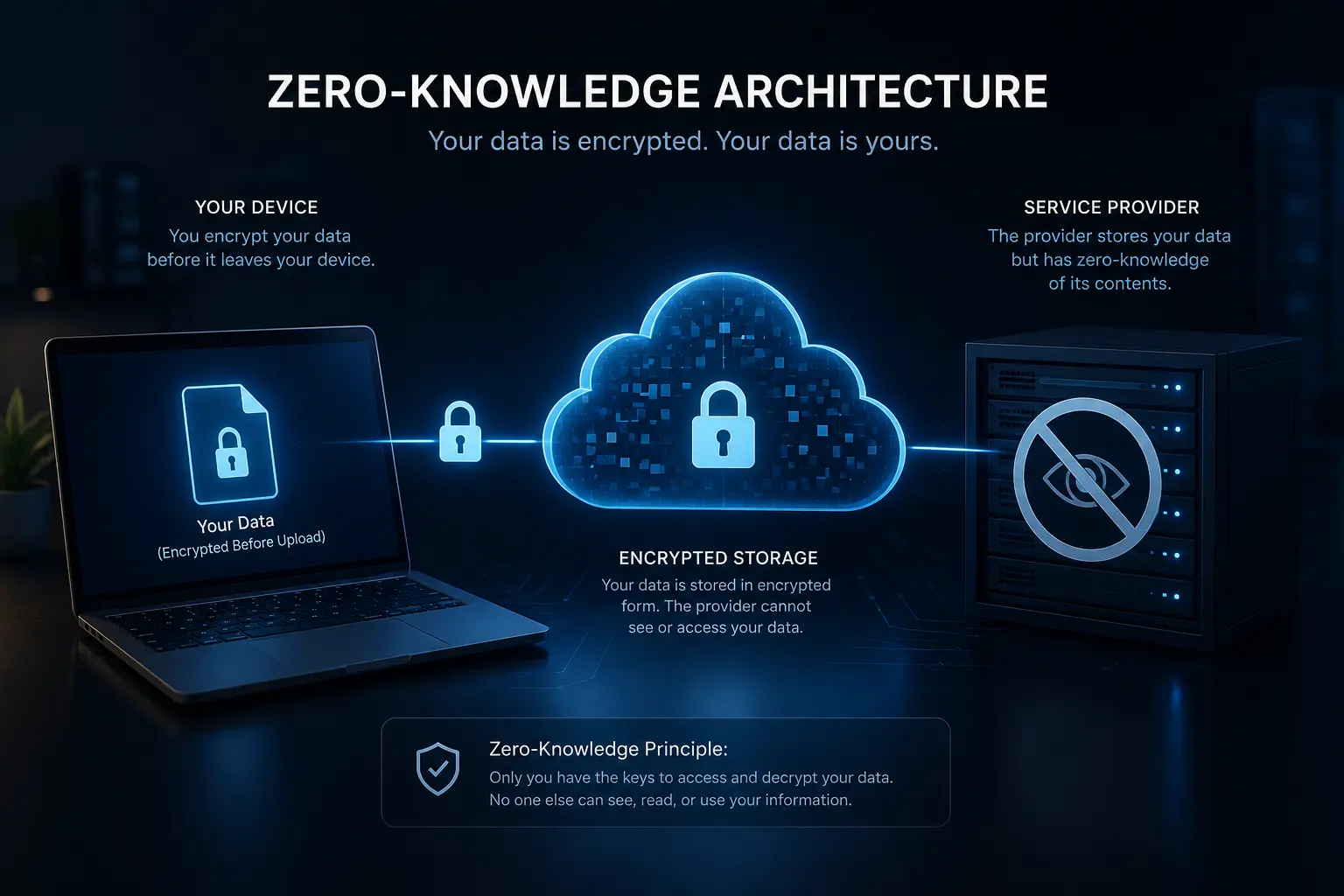
A simplified workflow looks like this:
- User generates or receives an encryption key.
- Files are encrypted locally.
- Encrypted files are stored remotely.
- The encryption key remains under user control.
- Data can only be decrypted by someone possessing the correct key.
The main advantage of this model is that even platform operators cannot access stored files in their original form.
However, users must carefully protect their recovery information because losing encryption keys may result in permanent loss of access to stored data.
Distributed Storage Network
Many discussions describe Anon Vault as using a distributed storage approach rather than relying on a single centralized server.
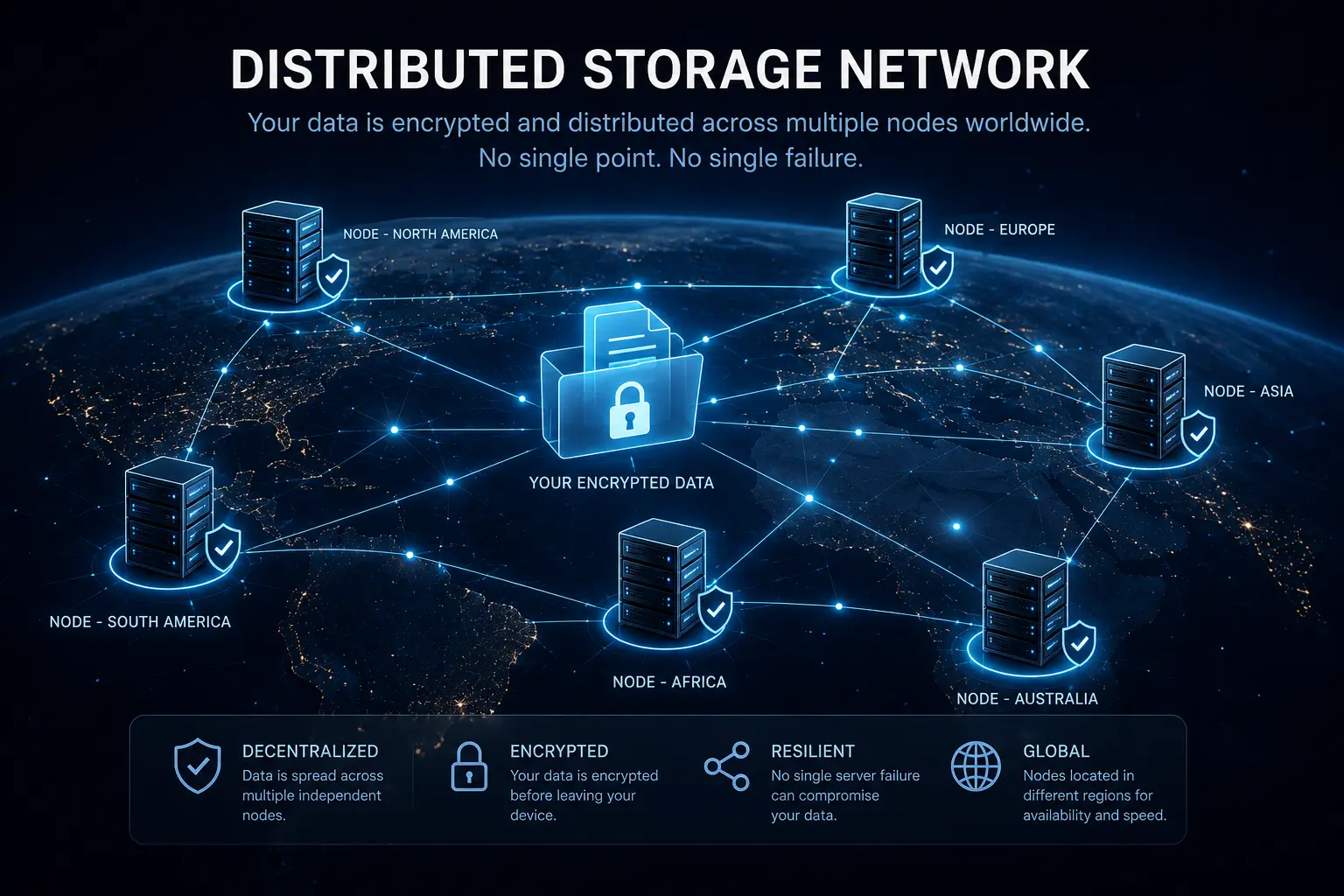
In a distributed architecture:
- Files may be divided into multiple encrypted fragments.
- Fragments can be stored across different servers or storage nodes.
- No single location contains the complete readable file.
- Redundancy helps improve availability and resilience.
This approach can offer several privacy and security benefits:
| Benefit | Description |
|---|---|
| Reduced Single Point of Failure | One compromised server does not expose all data |
| Improved Resilience | Data remains available even if some nodes fail |
| Enhanced Privacy | Storage fragments reveal little useful information individually |
| Better Fault Tolerance | Multiple copies can help prevent data loss |
Distributed storage is increasingly used in privacy-focused and decentralized cloud storage systems because it reduces dependence on a single infrastructure provider.
Identity-Free Registration
Another commonly referenced feature is the ability to create accounts with minimal personal information.
Traditional cloud storage services often require:
- Full name
- Email address
- Phone number
- Payment information
Privacy-focused platforms attempt to reduce these requirements by allowing users to register with limited identifying information.
Depending on the implementation, identity-free registration may include:
- Username-only account creation
- Anonymous authentication methods
- Privacy-preserving login systems
- Support for cryptocurrency payments
- Reduced collection of personal data
The goal is to minimize the amount of information that can be linked to a user’s stored files and online activity.
It is important to note that anonymity levels vary between services, and users should always review the platform’s privacy policy and registration requirements.
Data Retrieval Process
When a user wants to access stored files, the retrieval process typically reverses the upload workflow.
A simplified example looks like this:
- User authenticates with their account credentials.
- Encrypted file fragments are requested from storage nodes.
- Fragments are reassembled into a complete encrypted file.
- The user’s device applies the correct decryption key.
- The original file becomes accessible.
Throughout this process, encryption is intended to ensure that storage providers and unauthorized third parties cannot view the file contents.
How the Complete Process Works
The overall workflow can be summarized as follows:
| Step | Action |
|---|---|
| 1 | User selects a file |
| 2 | File is encrypted locally |
| 3 | Encrypted data is uploaded |
| 4 | Data is distributed across storage nodes |
| 5 | User authentication verifies access rights |
| 6 | Encrypted data is retrieved |
| 7 | Decryption occurs on the user’s device |
| 8 | Original file is restored |
By combining client-side encryption, zero-knowledge security principles, distributed storage, and reduced identity requirements, Anon Vault aims to provide stronger privacy protections than many traditional cloud storage services. Understanding these mechanisms is essential for evaluating both the benefits and limitations of any privacy-focused storage platform.
Core Features of Anon Vault
Anon Vault is frequently described as a privacy-focused cloud storage solution designed to give users greater control over their data. While specific implementations may vary, most discussions about Anon Vault highlight a common set of security and privacy features aimed at protecting files from unauthorized access and reducing exposure to data collection practices.
Below are the core features most commonly associated with Anon Vault.
End-to-End Encryption
End-to-end encryption is one of the most important security features attributed to Anon Vault.
With end-to-end encryption, files are encrypted before they leave the user’s device and remain encrypted while stored and transmitted. Only users who possess the correct decryption credentials can access the original file contents.
Key advantages include:
- Protection against unauthorized access
- Secure file transfers
- Reduced risk from server breaches
- Improved confidentiality for sensitive documents
This security model helps ensure that stored data remains protected even if storage infrastructure is compromised.
Anonymous Account Creation
Unlike many traditional cloud storage providers that require personal information during registration, Anon Vault is often associated with anonymous or low-information account creation.
Privacy-focused registration models may allow users to:
- Create accounts without providing extensive personal details
- Minimize identifiable information
- Reduce digital tracking
- Separate storage activities from personal identities
For privacy-conscious users, limiting the amount of collected information can be an important advantage.
Decentralized Storage
Another feature commonly linked to Anon Vault is decentralized or distributed storage.
Instead of storing all files on a single server, encrypted data may be divided and distributed across multiple storage nodes. This approach can improve both security and reliability.
Benefits of decentralized storage include:
| Benefit | Description |
|---|---|
| Enhanced Security | No single server contains all user data |
| Better Availability | Data remains accessible even if some nodes fail |
| Reduced Centralized Risk | Limits dependence on a single provider |
| Improved Fault Tolerance | Multiple storage locations help prevent data loss |
Distributed storage architectures are becoming increasingly popular in privacy-focused cloud environments.
Multi-Factor Authentication
Multi-factor authentication (MFA) adds an additional layer of protection beyond a password.
When MFA is enabled, users must provide a second verification factor before gaining access to their accounts. Common authentication methods include:
- Authentication apps
- Security codes
- Hardware security keys
- Biometric verification
This extra security layer helps protect accounts even if passwords are compromised.
Secure File Sharing
Secure file sharing allows users to share documents and files without exposing them publicly.
Privacy-focused file-sharing systems often include:
- Encrypted sharing links
- Access controls
- Password-protected downloads
- Expiration dates for shared files
- Permission management options
These controls help users maintain ownership and oversight of shared content.
Permanent Data Deletion
Data deletion is a critical aspect of privacy-focused storage services.
Anon Vault is often described as supporting secure deletion processes designed to remove files permanently when users choose to delete them.
Potential benefits include:
- Reduced risk of data recovery
- Greater control over stored information
- Improved compliance with privacy requirements
- Better management of sensitive files
For users handling confidential information, permanent deletion capabilities can be just as important as encryption.
Cross-Platform Access
Modern cloud storage solutions must work across multiple devices and operating systems. Anon Vault is frequently described as providing cross-platform accessibility that allows users to manage files from different environments.
Supported platforms may include:
- Windows
- macOS
- Linux
- Android
- iOS
- Web browsers
Cross-platform access enables users to securely retrieve, upload, and share files regardless of the device they are using.
Feature Summary
| Feature | Purpose |
|---|---|
| End-to-End Encryption | Protects files during storage and transfer |
| Anonymous Account Creation | Reduces collection of personal information |
| Decentralized Storage | Improves resilience and security |
| Multi-Factor Authentication | Adds an extra layer of account protection |
| Secure File Sharing | Enables controlled sharing of encrypted files |
| Permanent Data Deletion | Helps ensure removed files cannot be recovered |
| Cross-Platform Access | Allows secure access across multiple devices |
Together, these features form the foundation of Anon Vault’s privacy-focused approach. By combining encryption, anonymity, distributed storage, and advanced access controls, the platform aims to provide a more secure alternative to traditional cloud storage services for users who prioritize privacy and data ownership.
Anon Vault Security Architecture Explained
Security claims are one of the main reasons users become interested in Anon Vault. Many articles mention encryption, privacy, and anonymous storage, but few explain how these technologies work together to protect user data.
To evaluate whether a storage platform is truly secure, it is important to understand the underlying security architecture rather than relying solely on marketing terms. The sections below explain the technologies commonly associated with Anon Vault and the security considerations users should be aware of.
AES-256 Encryption
AES-256 (Advanced Encryption Standard with a 256-bit key) is widely regarded as one of the strongest encryption standards used in modern cybersecurity.
Many privacy-focused storage services use AES-256 to protect files before they are uploaded to cloud infrastructure. Once encrypted, files become unreadable without the correct decryption key.
The primary benefits of AES-256 include:
- Extremely large key space
- Strong resistance to brute-force attacks
- Industry-wide adoption
- Protection for data at rest and in transit
A simplified workflow looks like this:
- User selects a file.
- The file is encrypted using AES-256.
- The encrypted file is uploaded.
- Only authorized users with the correct key can decrypt the file.
For practical purposes, properly implemented AES-256 encryption is considered highly secure against current computing capabilities.
Encryption Keys and Ownership
Encryption is only as secure as the protection of the encryption keys.
In traditional cloud storage systems, providers often maintain some level of access to encryption infrastructure. Privacy-focused storage models attempt to shift key ownership to the user.
Under a user-controlled encryption model:
- Users control access to decryption keys.
- Service providers cannot easily read stored files.
- Data remains encrypted even on storage servers.
- Unauthorized parties cannot decrypt files without the correct credentials.
This approach increases privacy but also transfers greater responsibility to the user.
Why Key Ownership Matters
| Scenario | Provider-Controlled Keys | User-Controlled Keys |
|---|---|---|
| Provider Can Access Files | Possible | Typically No |
| User Controls Data Access | Limited | High |
| Privacy Protection | Moderate | Strong |
| Recovery Options | Easier | More Limited |
Greater control often comes with greater responsibility for protecting recovery information.
Zero-Knowledge Security Model
One of the most frequently discussed aspects of Anon Vault is its association with a zero-knowledge architecture.
A zero-knowledge model means the service provider stores encrypted data but does not possess the information required to decrypt it.
In theory:
- Files are encrypted before upload.
- Encryption keys remain with the user.
- Storage servers hold encrypted data only.
- Platform operators cannot view file contents.
This design offers several privacy advantages:
- Reduced insider threats
- Protection against unauthorized employee access
- Improved confidentiality
- Greater user control
However, the effectiveness of a zero-knowledge system depends entirely on correct implementation and independent verification.
Storage Fragmentation
Some descriptions of Anon Vault mention storage fragmentation as part of its security strategy.
Storage fragmentation involves dividing encrypted files into multiple pieces before storing them across different locations or nodes.
A simplified example:
| Stage | Action |
|---|---|
| File Upload | File is encrypted |
| Fragmentation | Encrypted file is split into pieces |
| Distribution | Fragments are stored separately |
| Retrieval | Fragments are reassembled |
| Decryption | Original file is restored |
Potential benefits include:
- Reduced risk from a single server compromise
- Increased resilience
- Improved fault tolerance
- Additional protection against unauthorized reconstruction
Even if a storage node is breached, attackers may obtain only a fragment of encrypted data rather than the complete file.
Blockchain Verification Claims
Some discussions surrounding Anon Vault reference blockchain-based verification systems.
The idea behind blockchain verification is to create an immutable record of certain storage activities, such as:
- File integrity verification
- Access logging
- Ownership confirmation
- Audit trails
Potential advantages include:
- Tamper-resistant records
- Improved transparency
- Enhanced verification capabilities
- Independent validation of stored data
However, users should exercise caution when evaluating blockchain-related claims.
Important questions include:
- Is blockchain actually used?
- What data is stored on-chain?
- How does verification work?
- Has the implementation been independently audited?
- Does blockchain improve security or simply add complexity?
Without public technical documentation, blockchain-related claims should be viewed as features that require independent verification.
Potential Attack Vectors
No storage platform is completely immune to security threats. Even strong encryption systems can be affected by weaknesses elsewhere in the security chain.
Common attack vectors that may affect privacy-focused storage platforms include:
Credential Theft
Attackers may attempt to steal usernames, passwords, or recovery credentials through phishing campaigns or malware.
Endpoint Compromise
If a user’s device is infected with malware, files can be stolen before encryption occurs.
Weak Passwords
Poor password practices remain one of the most common causes of account compromise.
Social Engineering
Attackers often target users rather than technology, attempting to trick them into revealing access credentials.
Misconfigured Sharing Permissions
Incorrect sharing settings can expose files even when encryption systems are functioning correctly.
Software Vulnerabilities
Unpatched applications, browsers, or operating systems may create opportunities for attackers.
The strongest encryption architecture can still be undermined by poor operational security practices.
What Happens If You Lose Your Keys?
One of the most important considerations in privacy-focused storage systems is key recovery.
When users control their own encryption keys, the platform may not be able to recover encrypted data if those keys are lost.
Possible consequences include:
- Permanent loss of file access
- Inability to recover encrypted documents
- Loss of backups stored within the platform
- Recovery challenges for shared files
Best Practices for Protecting Encryption Keys
- Store recovery keys in multiple secure locations.
- Use password managers with strong encryption.
- Maintain offline backups of recovery information.
- Enable multi-factor authentication.
- Test recovery procedures periodically.
Security Assessment
The security architecture commonly associated with Anon Vault combines several modern privacy technologies, including AES-256 encryption, user-controlled keys, zero-knowledge storage, and distributed data storage. Together, these mechanisms aim to reduce unauthorized access and strengthen user privacy.
However, security should not be evaluated solely on advertised features. Transparency, independent audits, public documentation, and proven implementation practices are equally important when assessing whether a storage platform can be trusted with sensitive information.
For most users, the real question is not whether the underlying technologies are secure, they generally are, but whether the specific implementation has been independently verified and maintained to the standards required for long-term trust.
Does Anon Vault Truly Protect Your Privacy?
Privacy is the primary reason most users explore Anon Vault. Many articles describe the platform as anonymous, encrypted, and privacy-focused. However, true privacy involves much more than encrypting files.
A common misconception is that encryption automatically guarantees anonymity. In reality, privacy depends on multiple factors, including what personal information is collected, what metadata is retained, how users connect to the service, and whether activity can be linked back to an individual.
To understand whether Anon Vault truly protects privacy, it is important to look beyond marketing claims and examine the potential limitations that affect nearly all online services.
Personal Data Collection
One of the biggest privacy questions is how much personal information a platform collects.
Traditional cloud storage providers often gather:
- Full names
- Email addresses
- Phone numbers
- Payment information
- Device information
- Usage analytics
Privacy-focused platforms attempt to reduce this data collection by requiring minimal account information.
Ideally, a privacy-centric storage service would collect only the information necessary to operate the platform.
Privacy Impact of Data Collection
| Data Type | Privacy Risk |
|---|---|
| Full Name | High |
| Email Address | Moderate |
| Phone Number | High |
| Payment Details | High |
| IP Address | Moderate to High |
| Device Information | Moderate |
| Anonymous Username | Low |
The less personally identifiable information collected, the harder it becomes to connect stored files to a real-world identity.
However, users should always review privacy policies carefully because even anonymous platforms may collect operational data for security, fraud prevention, or system maintenance.
Metadata Exposure Risks
Encryption protects file contents, but it does not always protect metadata.
Metadata is information about a file rather than the file itself.
Examples include:
- Upload dates
- File sizes
- Login timestamps
- Sharing activity
- Account creation dates
- Access frequency
Even when file contents remain encrypted, metadata can reveal significant information about user behavior.
Example
Imagine an encrypted file named “Financial Report.pdf.”
The contents may be protected, but metadata could still reveal:
- The file was uploaded yesterday.
- It is 25 MB in size.
- It was shared with another account.
- It is accessed every Monday morning.
While this information does not reveal the actual contents, it can provide valuable intelligence about user activity.
This is why privacy experts often distinguish between:
| Protection Type | What It Protects |
|---|---|
| Content Privacy | File contents |
| Metadata Privacy | User activity patterns |
Many cloud storage platforms focus heavily on content encryption while providing less protection against metadata collection.
IP Address Tracking Considerations
Even if a platform supports anonymous registration, internet connections still generate IP addresses.
An IP address can reveal:
- Approximate location
- Internet service provider
- Connection history
- Access patterns
For security and abuse prevention purposes, many online services temporarily log IP addresses.
Potential privacy concerns include:
- Activity correlation
- Geographic tracking
- Account linking
- Legal requests for access logs
A platform may not know a user’s real name, but persistent IP logging can still create a profile of account activity.
Privacy-conscious users often use additional tools such as VPN services or anonymity networks to reduce exposure.
Browser Fingerprinting Risks
One of the most overlooked privacy risks is browser fingerprinting.
Unlike cookies, fingerprinting identifies users based on characteristics of their devices and browsers.
A fingerprint may include:
- Operating system
- Browser version
- Screen resolution
- Installed fonts
- Language settings
- Time zone
- Device hardware characteristics
When combined, these attributes can create a highly unique identifier.
Why Fingerprinting Matters
Even if:
- Cookies are blocked
- Anonymous accounts are used
- Personal information is not provided
A unique browser fingerprint may still allow activity to be linked across sessions.
This is one reason privacy experts emphasize that anonymity and privacy are not the same thing.
Strong encryption protects files, but it does not automatically prevent browser fingerprinting.
Anonymous Payments
Payment methods can significantly affect privacy.
Traditional payment systems often require:
- Names
- Billing addresses
- Banking information
- Credit card details
These details can directly connect an account to a real-world identity.
Privacy-focused services sometimes support alternative payment methods such as:
- Cryptocurrencies
- Privacy-oriented digital assets
- Gift cards
- Prepaid payment solutions
Comparison of Payment Privacy
| Payment Method | Privacy Level |
|---|---|
| Credit Card | Low |
| Bank Transfer | Low |
| PayPal | Moderate |
| Cryptocurrency | Moderate to High |
| Privacy Coins | Higher |
| Prepaid Methods | Moderate |
It is important to understand that payment anonymity depends not only on the platform but also on how the payment itself is conducted.
Tor Compatibility
Some discussions surrounding Anon Vault reference compatibility with the Tor network.
Tor (The Onion Router) is a privacy network designed to conceal a user’s IP address by routing traffic through multiple encrypted nodes.
Potential benefits include:
- IP address protection
- Location obfuscation
- Reduced tracking
- Increased anonymity
When a privacy-focused storage platform supports Tor, users may gain additional protection against network-level tracking.
However, Tor is not a complete privacy solution.
Users can still expose identifying information through:
- Browser fingerprinting
- Account behavior
- Shared files
- Reused credentials
- External communications
True anonymity requires multiple layers of protection rather than relying on a single technology.
The Privacy Reality Check
One of the biggest misconceptions in cloud storage is the belief that encryption automatically guarantees privacy.
In reality, privacy depends on several factors working together:
| Privacy Layer | Purpose |
|---|---|
| Encryption | Protects file contents |
| Zero-Knowledge Storage | Prevents provider access |
| Minimal Data Collection | Reduces identity exposure |
| Metadata Protection | Limits activity tracking |
| Anonymous Payments | Reduces financial linkage |
| Tor or VPN Usage | Protects network identity |
| Anti-Fingerprinting Measures | Reduces device tracking |
A weakness in any one of these areas can reduce overall privacy.
Anon Vault vs Traditional Cloud Storage
Choosing between Anon Vault and a traditional cloud storage provider depends on your priorities. If your main goal is convenience, collaboration, and integration with popular productivity tools, mainstream platforms such as Google Drive, Dropbox, and OneDrive may be suitable. However, if privacy, anonymity, and data ownership are your primary concerns, privacy-focused storage solutions often provide additional protections.
Traditional cloud storage services are designed for mass adoption and seamless collaboration. As a result, they typically collect more user information, maintain detailed account records, and integrate closely with advertising, productivity, or enterprise ecosystems.
Anon Vault, by contrast, is commonly described as prioritizing privacy through encryption, reduced data collection, and user-controlled security practices.
Comparison Table
| Feature | Anon Vault | Google Drive | Dropbox | OneDrive |
|---|---|---|---|---|
| Anonymous Signup | Yes | No | No | No |
| End-to-End Encryption | Yes | Partial | Partial | Partial |
| Zero-Knowledge Storage | Yes | No | No | No |
| Metadata Collection | Minimal | Extensive | Extensive | Extensive |
| Decentralized Storage | Yes | No | No | No |
| User Control of Encryption Keys | High | Limited | Limited | Limited |
| Personal Data Requirements | Low | High | High | High |
| Privacy Focus | High | Moderate | Moderate | Moderate |
| Third-Party Access Risk | Lower | Higher | Higher | Higher |
| Productivity Tool Integration | Limited | Extensive | Extensive | Extensive |
| Collaboration Features | Moderate | Advanced | Advanced | Advanced |
| Recovery Options | Limited | Strong | Strong | Strong |
Anonymous Signup
One of the most significant differences is account creation.
Most traditional cloud storage providers require:
- Email addresses
- Personal information
- Identity-linked accounts
- Payment details for premium plans
Privacy-focused services often attempt to reduce these requirements, allowing users to create accounts with minimal personal information.
For users seeking anonymity, this can be a major advantage.
End-to-End Encryption
End-to-end encryption ensures that files remain encrypted throughout storage and transmission.
While Google Drive, Dropbox, and OneDrive encrypt data, they generally manage encryption infrastructure themselves and may retain the technical ability to access data under certain circumstances.
Privacy-focused platforms typically aim to ensure that only the user can decrypt stored files.
Why This Matters
| Scenario | Traditional Storage | Privacy-Focused Storage |
|---|---|---|
| Provider Can Access File Contents | Possible | Typically No |
| User Controls Decryption Keys | Limited | Yes |
| Insider Access Risk | Higher | Lower |
| Data Confidentiality | Moderate | High |
Zero-Knowledge Storage
Zero-knowledge architecture is one of the largest differences between privacy-first and traditional storage platforms.
In a zero-knowledge system:
- Files are encrypted before upload.
- Providers cannot view file contents.
- Encryption keys remain under user control.
Most mainstream cloud providers do not operate under a strict zero-knowledge model.
This means users must place a greater degree of trust in the provider’s security practices and internal controls.
Metadata Collection
Many users focus on file encryption while overlooking metadata.
Traditional cloud platforms often collect information such as:
- Login activity
- Device information
- Access timestamps
- Sharing activity
- Usage analytics
Even when files are encrypted, metadata can reveal a significant amount about user behavior.
Privacy-focused platforms generally attempt to minimize metadata collection wherever possible.
Decentralized Storage
Traditional cloud storage providers use centralized infrastructure managed by their own data centers and cloud networks.
Anon Vault is often described as incorporating decentralized or distributed storage concepts.
Potential advantages include:
- Reduced single points of failure
- Increased resilience
- Better fault tolerance
- Enhanced privacy protections
By distributing encrypted data across multiple storage locations, decentralized architectures can make unauthorized access more difficult.
Data Ownership and Control
One of the most important differences is how much control users have over their data.
Traditional providers prioritize convenience and recovery options. If users forget passwords, account recovery processes are usually available.
Privacy-focused platforms often place greater emphasis on user ownership, which means:
- More control over encryption keys
- Less provider access
- Greater responsibility for account recovery
This tradeoff improves privacy but can increase the risk of permanent data loss if credentials are lost.
Convenience vs Privacy
The choice between traditional cloud storage and privacy-focused alternatives often comes down to priorities.
Traditional Cloud Storage Strengths
- Easy collaboration
- Seamless integrations
- Advanced productivity tools
- Simple account recovery
- Large storage ecosystems
Privacy-Focused Storage Strengths
- Reduced data collection
- Stronger confidentiality
- Greater user control
- Better anonymity
- Enhanced protection against provider access
Which Option Is Better?
There is no universal answer because different users have different needs.
Traditional cloud storage may be a better choice for:
- Everyday file sharing
- Team collaboration
- Productivity workflows
- Users who prioritize convenience
Privacy-focused storage may be a better choice for:
- Journalists
- Researchers
- Privacy-conscious individuals
- Cryptocurrency users
- Organizations handling sensitive information
Anon Vault vs Privacy-Focused Alternatives
While many articles compare Anon Vault to mainstream services such as Google Drive or Dropbox, few examine how it stacks up against established privacy-focused cloud storage providers. This is an important comparison because users searching for anonymous storage are usually deciding between multiple privacy-oriented solutions rather than between privacy-focused and mainstream platforms.
Providers such as Proton Drive, Tresorit, Sync.com, NordLocker, and MEGA have built reputations around encryption, secure file sharing, and data privacy. Comparing these services helps users understand where Anon Vault may offer advantages and where established competitors may provide stronger transparency, infrastructure, and trust.
Quick Comparison Table
| Feature | Anon Vault | Proton Drive | Tresorit | Sync.com | NordLocker | MEGA |
|---|---|---|---|---|---|---|
| End-to-End Encryption | Yes | Yes | Yes | Yes | Yes | Yes |
| Zero-Knowledge Architecture | Yes | Yes | Yes | Yes | Yes | Yes |
| Anonymous Signup | Yes | Partial | No | No | Partial | Partial |
| Open Security Documentation | Limited | Extensive | Extensive | Good | Good | Extensive |
| Independent Security Reputation | Limited | Strong | Strong | Strong | Strong | Strong |
| Business Features | Limited | Growing | Advanced | Advanced | Moderate | Moderate |
| Secure File Sharing | Yes | Yes | Yes | Yes | Yes | Yes |
| Cross-Platform Support | Yes | Yes | Yes | Yes | Yes | Yes |
| Transparency | Limited | High | High | High | High | High |
| Public Company Information | Limited | High | High | High | High | High |
Anon Vault vs Proton Drive
Proton Drive is developed by the team behind Proton Mail and is widely recognized in the privacy industry.
Where Proton Drive Has the Advantage
- Established company reputation
- Public leadership team
- Independent security research
- Strong privacy policies
- Extensive technical documentation
- Integration with Proton ecosystem
Where Anon Vault May Have the Advantage
- Greater emphasis on anonymity
- Reduced account identification requirements
- Potentially lower data collection
Best Choice For
| User Type | Recommended Service |
|---|---|
| Maximum Transparency | Proton Drive |
| Greater Anonymity | Anon Vault |
| Business Use | Proton Drive |
| Long-Term Reliability | Proton Drive |
Anon Vault vs Tresorit
Tresorit focuses heavily on enterprise-grade security and compliance.
Tresorit Strengths
- Zero-knowledge encryption
- Enterprise security controls
- Regulatory compliance support
- Advanced sharing permissions
- Audit and monitoring features
Anon Vault Strengths
- Privacy-focused approach
- Potentially more anonymous onboarding
- Simpler privacy-first positioning
Best Choice For
- Businesses → Tresorit
- Compliance-focused organizations → Tresorit
- Privacy enthusiasts → Anon Vault
Anon Vault vs Sync.com
Sync.com has become one of the most popular zero-knowledge cloud storage providers.
Sync.com Advantages
- Mature infrastructure
- Strong encryption implementation
- Secure collaboration tools
- Competitive pricing
- Established reputation
Anon Vault Advantages
- Anonymous storage focus
- Reduced personal information requirements
- Potentially greater privacy orientation
Best Choice For
| Priority | Better Option |
|---|---|
| Ease of Use | Sync.com |
| Team Collaboration | Sync.com |
| Anonymous Usage | Anon Vault |
| Proven Track Record | Sync.com |
Anon Vault vs NordLocker
NordLocker is developed by the team behind NordVPN and focuses on encrypted file protection.
NordLocker Strengths
- Well-known cybersecurity company
- Strong encryption standards
- User-friendly interface
- Excellent cross-platform support
- Trusted security ecosystem
Anon Vault Strengths
- Greater emphasis on anonymity
- Reduced identity requirements
- Privacy-first storage model
Best Choice For
- General consumers → NordLocker
- Privacy enthusiasts → Anon Vault
- Existing Nord users → NordLocker
Anon Vault vs MEGA
MEGA is one of the most recognizable privacy-focused cloud storage platforms.
MEGA Advantages
- Large user base
- End-to-end encryption
- Generous free storage
- Extensive platform support
- Mature infrastructure
Anon Vault Advantages
- Stronger anonymity positioning
- Lower emphasis on identity-based services
- Privacy-centric branding
Best Choice For
- Large storage needs → MEGA
- Long-term platform stability → MEGA
- Anonymous cloud storage exploration → Anon Vault
Transparency and Trust Comparison
One area where established competitors currently have a significant advantage is transparency.
| Provider | Public Leadership | Security Documentation | Independent Reputation |
|---|---|---|---|
| Anon Vault | Limited | Limited | Limited |
| Proton Drive | Yes | Extensive | Strong |
| Tresorit | Yes | Extensive | Strong |
| Sync.com | Yes | Strong | Strong |
| NordLocker | Yes | Strong | Strong |
| MEGA | Yes | Extensive | Strong |
For privacy-focused services, encryption is important, but transparency also plays a major role in building trust.
A provider with strong encryption but limited public accountability may still present uncertainty for users storing highly sensitive information.
Which Privacy Storage Service Is Best?
The best service depends on what you value most.
Choose Anon Vault If:
- Anonymity is your top priority.
- You want minimal personal information requirements.
- You prefer privacy-focused storage concepts.
- You are comfortable researching platform transparency independently.
Choose Proton Drive If:
- You want a balance of privacy and trust.
- You prefer a well-documented security model.
- You value transparency and long-term stability.
Choose Tresorit If:
- You need enterprise-grade security.
- Compliance and business controls are important.
- Your organization handles highly sensitive information.
Choose Sync.com If:
- You want strong privacy with excellent usability.
- Collaboration features matter.
- You need a mature and trusted platform.
Choose NordLocker If:
- You want simple encrypted storage.
- You already use Nord security products.
- Ease of use is a priority.
Choose MEGA If:
- You need substantial storage capacity.
- You want a long-established encrypted storage platform.
- Cross-platform accessibility is important.
Final Verdict
Anon Vault differentiates itself through its focus on anonymity and privacy-first storage concepts. However, established competitors such as Proton Drive, Tresorit, Sync.com, NordLocker, and MEGA currently offer stronger public documentation, clearer ownership structures, proven security track records, and greater organizational transparency.
For users seeking the highest level of trust and verification, Proton Drive, Tresorit, and Sync.com are generally safer choices due to their established reputations and transparent security practices.
For users whose primary goal is maximizing anonymity and minimizing personal data exposure, Anon Vault may be appealing, but its limited public transparency means it should be evaluated carefully before being trusted with highly sensitive information.
Winner by Category
| Category | Winner |
|---|---|
| Best Overall Privacy Storage | Proton Drive |
| Best Enterprise Security | Tresorit |
| Best Value for Individuals | Sync.com |
| Best User Experience | NordLocker |
| Best Storage Capacity | MEGA |
| Best for Anonymity | Anon Vault |
| Best Balance of Privacy and Trust | Proton Drive |
Benefits of Using Anon Vault
The growing interest in Anon Vault is driven by one core idea: giving users greater control over their digital privacy. While traditional cloud storage services prioritize convenience and collaboration, privacy-focused platforms aim to reduce data exposure, limit tracking, and strengthen user control over sensitive information.
For individuals and organizations concerned about surveillance, data collection, or unauthorized access, Anon Vault offers several potential advantages.
Better Privacy
Privacy is the primary benefit associated with Anon Vault.
Traditional cloud storage providers often collect account information, usage data, and various forms of metadata. Privacy-focused storage platforms attempt to minimize this collection and provide stronger protections around stored files.
Potential privacy benefits include:
- Reduced personal data collection
- Encrypted file storage
- Limited provider access to file contents
- Greater confidentiality for sensitive documents
- Improved protection against unauthorized viewing
For users handling personal, financial, legal, or business information, stronger privacy controls can help reduce unnecessary exposure.
Reduced Tracking
Many online services collect information about how users interact with their platforms.
This data may include:
- Login history
- Device information
- Location data
- Usage patterns
- File-sharing activity
- Access frequency
Anon Vault is often promoted as a solution that minimizes data collection and tracking wherever possible.
Traditional Storage vs Privacy-Focused Storage
| Activity | Traditional Storage | Privacy-Focused Storage |
|---|---|---|
| User Analytics | Extensive | Limited |
| Behavioral Tracking | Common | Reduced |
| Metadata Collection | Higher | Lower |
| Advertising Integration | Possible | Rare |
| Identity Profiling | More Common | Less Common |
Reducing tracking helps users maintain greater control over their online activities and digital footprint.
Stronger Data Ownership
One of the biggest concerns with cloud storage is who ultimately controls access to stored information.
In many traditional systems:
- Providers manage encryption infrastructure.
- Recovery processes are controlled by the platform.
- User data may be subject to provider policies.
- Access permissions depend on centralized systems.
Privacy-focused storage platforms often place more control directly in the hands of users.
This can include:
- User-controlled encryption keys
- Zero-knowledge security models
- Reduced provider access
- Greater control over file permissions
Why Data Ownership Matters
When users control their encryption keys, ownership extends beyond simply storing files. It also determines who can access, share, recover, or decrypt that information.
This creates a stronger sense of digital ownership and reduces dependence on third-party providers.
Protection Against Centralized Breaches
Large centralized cloud platforms are attractive targets for cybercriminals because they store enormous amounts of data in a single ecosystem.
When centralized systems experience security incidents, millions of users may be affected.
Privacy-focused storage models attempt to reduce this risk through techniques such as:
- End-to-end encryption
- Distributed storage architectures
- Storage fragmentation
- Zero-knowledge systems
Centralized vs Distributed Risk
| Security Factor | Centralized Storage | Distributed Storage |
|---|---|---|
| Single Point of Failure | High | Lower |
| Impact of Server Breach | Greater | Reduced |
| Data Concentration | High | Lower |
| Resilience | Moderate | Higher |
Even if attackers gain access to storage infrastructure, encrypted and fragmented data is generally more difficult to exploit than unprotected information.
Anonymous Collaboration
Many cloud storage users need to share files with colleagues, clients, partners, or team members. However, collaboration often requires exposing personal information or creating identity-linked accounts.
Anon Vault is frequently associated with privacy-focused sharing mechanisms that aim to protect both file contents and user identities.
Potential collaboration benefits include:
- Secure file sharing
- Encrypted access links
- Reduced identity exposure
- Controlled permissions
- Password-protected sharing
- Temporary access options
This can be particularly valuable for:
- Journalists
- Researchers
- Activists
- Remote teams
- Cryptocurrency communities
- Privacy-conscious organizations
Anonymous collaboration allows users to exchange information while minimizing unnecessary personal data disclosure.
Summary of Key Benefits
| Benefit | Why It Matters |
|---|---|
| Better Privacy | Helps protect sensitive information from unnecessary exposure |
| Reduced Tracking | Limits collection of behavioral and usage data |
| Stronger Data Ownership | Gives users greater control over access and encryption |
| Protection Against Centralized Breaches | Reduces risks associated with large centralized storage systems |
| Anonymous Collaboration | Enables secure file sharing with fewer privacy compromises |
Potential Risks and Limitations
While most articles about Anon Vault focus on privacy, encryption, and anonymity, far fewer discuss the potential risks that users should consider before trusting any privacy-focused storage platform.
Strong security features do not automatically eliminate risk. In fact, some privacy-focused systems introduce unique challenges that are not present with traditional cloud storage providers. Understanding these limitations is essential for making an informed decision, especially when storing sensitive personal, financial, legal, or business information.
The following considerations represent some of the most important questions users should evaluate before relying on Anon Vault or any anonymous cloud storage service.
Limited Transparency
Transparency is one of the biggest concerns surrounding Anon Vault.
Established cloud storage providers typically publish information about:
- Company ownership
- Leadership teams
- Security practices
- Compliance certifications
- Infrastructure locations
- Incident response procedures
In contrast, publicly available information about Anon Vault appears limited. Users may find it difficult to verify:
- Who operates the platform
- Where the company is based
- How infrastructure is managed
- What security processes are in place
- How customer data is handled
Why Transparency Matters
Privacy requires trust.
Even if a platform advertises strong encryption, users still need confidence that the service is being operated responsibly and securely.
A lack of transparency can make it harder to evaluate:
- Security claims
- Business stability
- Legal protections
- Accountability mechanisms
For highly sensitive data, transparency is often just as important as encryption.
Lack of Independent Security Audits
One of the strongest indicators of security maturity is an independent audit.
Many leading privacy-focused providers regularly undergo:
- Security assessments
- Penetration testing
- Code reviews
- Compliance evaluations
- Infrastructure audits
Independent audits help verify whether security claims match real-world implementation.
Questions Users Should Ask
- Has the platform been audited?
- Who performed the audit?
- Is the audit publicly available?
- Were vulnerabilities identified and fixed?
- How frequently are audits conducted?
Without independent verification, users must rely largely on the provider’s own claims about security and privacy.
Key Management Responsibility
Privacy-focused storage systems often place encryption keys under the user’s control.
This provides stronger privacy because providers cannot easily access stored files. However, it also shifts responsibility to the user.
Benefits of User-Controlled Keys
- Better privacy
- Reduced provider access
- Stronger data ownership
Risks of User-Controlled Keys
- Lost keys may mean lost files.
- Recovery options may be limited.
- Users become responsible for key security.
- Poor backup practices can create permanent data loss.
Many users underestimate how important encryption key management becomes in a zero-knowledge storage environment.
Data Recovery Challenges
Traditional cloud providers typically offer account recovery options through:
- Email verification
- Phone verification
- Identity checks
- Customer support
Privacy-focused platforms often provide fewer recovery mechanisms because retaining recovery access could weaken privacy protections.
Comparison
| Recovery Factor | Traditional Storage | Privacy-Focused Storage |
|---|---|---|
| Password Recovery | Easy | Limited |
| Provider Assistance | Extensive | Limited |
| Identity Verification | Available | Often Minimal |
| Lost Encryption Key Recovery | Possible in Some Cases | Often Impossible |
| Risk of Permanent Data Loss | Lower | Higher |
This creates a tradeoff between convenience and privacy.
The stronger the privacy model becomes, the less ability the provider may have to help recover lost data.
Jurisdiction Risks
Where a storage provider operates can significantly affect user privacy.
Different countries have different laws governing:
- Data retention
- Government access requests
- Surveillance programs
- User privacy protections
- Cross-border data transfers
When evaluating a privacy-focused service, users should understand:
- Which country governs the service
- Where data is stored
- Which laws apply
- Whether authorities can compel access
Why Jurisdiction Matters
Even the strongest encryption system exists within a legal framework.
Understanding that framework helps users assess potential privacy risks and compliance obligations.
Trust Issues With Anonymous Providers
Anonymity can be attractive from a privacy perspective, but it can also create trust challenges.
If little is known about the people or organization operating a service, users may struggle to evaluate:
- Technical competence
- Security expertise
- Business legitimacy
- Long-term reliability
- Incident response capabilities
Trust Evaluation Checklist
Before trusting any privacy-focused provider, consider:
- Is the team publicly known?
- Are security policies documented?
- Are transparency reports available?
- Have independent audits been completed?
- Is customer support accessible?
- Is there a public track record?
The less information available, the more difficult it becomes to independently verify trustworthiness.
Vendor Longevity Concerns
Cloud storage is often used for long-term file preservation.
Users may store:
- Family photos
- Legal documents
- Business records
- Research data
- Financial information
As a result, platform stability is an important consideration.
Potential concerns include:
- Business closure
- Infrastructure changes
- Financial instability
- Service discontinuation
- Reduced support over time
Why Longevity Matters
Imagine storing critical files for several years only to discover that the service is no longer operating.
Questions users should consider include:
- How long has the platform existed?
- Does it have a sustainable business model?
- Is there an active development team?
- Are updates released regularly?
- Is there evidence of long-term planning?
Longevity is often overlooked but can become a major factor when choosing a storage provider.
Risk Assessment Summary
| Risk Area | Potential Impact |
|---|---|
| Limited Transparency | Difficult to verify claims and accountability |
| Lack of Security Audits | Security promises may remain unverified |
| Key Management Responsibility | Users bear responsibility for access control |
| Data Recovery Challenges | Lost credentials may result in permanent data loss |
| Jurisdiction Risks | Legal frameworks may affect privacy protections |
| Anonymous Provider Concerns | Trust can be difficult to establish |
| Vendor Longevity Issues | Long-term availability may be uncertain |
Who Should Use Anon Vault?
Anon Vault is not designed for every type of user. Its strongest selling points are privacy, encryption, anonymity, and user control rather than convenience or deep integration with productivity ecosystems.
For people who prioritize confidentiality and data protection, the platform’s privacy-focused approach may provide meaningful advantages over traditional cloud storage services. Below are the types of users who are most likely to benefit from a service like Anon Vault.
Journalists
Journalists often work with sensitive information, confidential documents, and protected sources.
A privacy-focused storage platform can help journalists:
- Store research materials securely
- Protect source-related documents
- Reduce exposure to unauthorized access
- Share files more securely with editors and collaborators
- Maintain greater control over sensitive information
For investigative reporting and source protection, strong encryption and reduced data collection can provide additional layers of security.
Activists
Activists operating in sensitive environments frequently face privacy and surveillance concerns.
Privacy-focused cloud storage may help by:
- Protecting sensitive communications
- Securing organizational documents
- Limiting exposure of personal information
- Supporting safer file sharing
- Reducing unnecessary data collection
For individuals working on social, political, environmental, or human rights initiatives, privacy tools can play an important role in protecting both information and participants.
Cryptocurrency Users
Cryptocurrency communities have historically been early adopters of privacy-focused technologies.
Many cryptocurrency users store:
- Wallet backups
- Recovery phrases
- Transaction records
- Research documents
- Investment records
While highly sensitive credentials should never be stored carelessly, encrypted storage platforms can offer stronger protection than standard cloud storage solutions.
Potential benefits for cryptocurrency users include:
- Reduced identity exposure
- Enhanced file confidentiality
- Greater control over sensitive records
- Privacy-focused account management
Users should still follow best practices and maintain secure offline backups of critical recovery information.
Privacy-Conscious Individuals
Not everyone seeking privacy is a journalist, activist, or cryptocurrency user.
Many everyday users simply want greater control over their personal information.
Examples include:
- Personal documents
- Tax records
- Financial files
- Medical paperwork
- Family archives
- Private photos and videos
Privacy-conscious individuals often choose encrypted storage because they want to reduce tracking, limit data collection, and protect sensitive files from unauthorized access.
For these users, privacy is less about secrecy and more about maintaining control over personal information.
Businesses Handling Sensitive Data
Organizations that manage confidential information may benefit from stronger privacy protections.
Examples include:
- Legal firms
- Consulting companies
- Financial service providers
- Research organizations
- Healthcare-related businesses
- Technology companies
Potential advantages include:
- Secure document storage
- Encrypted collaboration
- Controlled file sharing
- Reduced exposure to unauthorized access
- Better protection of confidential records
However, businesses should also evaluate compliance requirements, audit capabilities, service-level agreements, and long-term vendor stability before adopting any storage platform.
Remote Teams
Remote work environments often depend heavily on cloud storage and file-sharing systems.
Teams frequently exchange:
- Project documentation
- Internal reports
- Client files
- Contracts
- Research materials
Privacy-focused storage can help remote teams:
- Protect confidential information
- Reduce third-party access risks
- Improve file-sharing security
- Maintain greater control over organizational data
For distributed teams handling sensitive information, stronger encryption and access controls can provide additional peace of mind.
Ideal User Profile
Anon Vault may be a strong fit for users who value:
- Privacy over convenience
- Data ownership over provider control
- Encryption over extensive integrations
- Confidentiality over advertising-driven ecosystems
- User-controlled security over simplified recovery systems
User Suitability Matrix
| User Type | Suitability |
|---|---|
| Journalists | High |
| Activists | High |
| Cryptocurrency Users | High |
| Privacy-Conscious Individuals | High |
| Businesses Handling Sensitive Data | Moderate to High |
| Remote Teams | Moderate to High |
| Casual Cloud Storage Users | Moderate |
| Users Prioritizing Convenience | Lower |
| Users Needing Extensive Productivity Integrations | Lower |
How to Set Up Anon Vault
Getting started with Anon Vault typically involves more than simply creating an account and uploading files. Because privacy-focused storage platforms place a strong emphasis on security and user-controlled encryption, proper setup is essential to maximize privacy and prevent accidental data loss.
The exact steps may vary depending on the platform’s implementation, but the process below reflects the security practices commonly recommended for privacy-focused cloud storage services.
Important: Because publicly available documentation about Anon Vault is limited, use this guide as a general privacy-focused setup framework rather than an official installation manual.
Step 1: Create an Account
The first step is creating your Anon Vault account.
Privacy-focused platforms often aim to minimize the amount of personal information required during registration.
Depending on the service configuration, registration may involve:
- Choosing a username
- Creating a strong password
- Setting up authentication credentials
- Selecting a storage plan
- Verifying account ownership if required
Best Practices During Registration
- Use a unique username.
- Avoid reusing passwords from other accounts.
- Consider using a dedicated email address if email registration is required.
- Review the privacy policy before creating an account.
- Avoid sharing unnecessary personal information.
Step 2: Configure Security Settings
Before uploading any files, take time to strengthen your account security.
Many users skip this step, but it is one of the most important parts of protecting your data.
Recommended Security Settings
Enable Multi-Factor Authentication (MFA)
MFA requires a second verification method in addition to your password.
Common options include:
- Authentication apps
- Security keys
- One-time verification codes
Use a Strong Password
A strong password should be:
- Long
- Unique
- Difficult to guess
- Stored in a reputable password manager
Review Account Permissions
Check:
- Active sessions
- Connected devices
- Sharing permissions
- Security notifications
Security Setup Checklist
| Setting | Recommended |
|---|---|
| Strong Password | Yes |
| Multi-Factor Authentication | Yes |
| Device Verification | Yes |
| Login Alerts | Yes |
| Recovery Information | Yes |
Step 3: Upload Files Securely
Once your account is secured, you can begin storing files.
Before uploading sensitive information, consider organizing your data based on security requirements.
Files Commonly Stored in Privacy-Focused Platforms
- Personal documents
- Financial records
- Business files
- Research materials
- Contracts
- Encrypted backups
Upload Security Tips
- Verify files before uploading.
- Remove unnecessary copies.
- Encrypt highly sensitive files locally when possible.
- Use secure networks during uploads.
- Avoid public Wi-Fi when handling confidential information.
Recommended File Organization
| Folder Type | Example Content |
|---|---|
| Personal | IDs, tax documents, records |
| Business | Contracts, reports, client files |
| Backups | Encrypted archives |
| Shared Files | Team collaboration documents |
| Archives | Historical records |
A structured file system makes security management easier over time.
Step 4: Enable Additional Privacy Protections
Encryption alone does not guarantee complete privacy.
To reduce digital exposure, consider enabling additional privacy measures where available.
Privacy Enhancements to Consider
Limit Personal Information
Only provide information that is necessary for account functionality.
Review Sharing Settings
Ensure that:
- Shared links are protected.
- Access permissions are restricted.
- Expiration dates are used when appropriate.
Monitor Account Activity
Regularly review:
- Login history
- Active sessions
- Shared files
- Permission settings
Use Privacy Tools
Many privacy-conscious users combine encrypted storage with:
- VPN services
- Privacy-focused browsers
- Anti-tracking extensions
- Secure password managers
Additional Privacy Checklist
| Privacy Measure | Recommended |
|---|---|
| Minimal Personal Information | Yes |
| Secure Sharing Links | Yes |
| Activity Monitoring | Yes |
| VPN Usage | Optional |
| Privacy-Focused Browser | Optional |
Step 5: Backup Recovery Keys
This is arguably the most important step in the entire setup process.
Many privacy-focused storage platforms rely on user-controlled encryption. If recovery keys, passwords, or authentication credentials are lost, access to files may become permanently unavailable.
Why Recovery Keys Matter
Recovery keys may be required to:
- Restore account access
- Recover encrypted files
- Verify account ownership
- Rebuild authentication settings
Without them, recovery may be impossible.
Best Practices for Recovery Key Storage
- Store keys in multiple secure locations.
- Keep at least one offline copy.
- Use encrypted password managers.
- Protect backups from unauthorized access.
- Test recovery procedures periodically.
Storage Options
| Method | Security Level |
|---|---|
| Encrypted Password Manager | High |
| Offline Encrypted USB Drive | High |
| Printed Secure Backup | Moderate to High |
| Plain Text Document | Low |
| Email Storage | Low |
Common Setup Mistakes to Avoid
Many privacy and security problems result from user mistakes rather than platform vulnerabilities.
Avoid these common errors:
- Using weak passwords
- Skipping MFA setup
- Sharing unrestricted file links
- Storing recovery keys in one location only
- Uploading sensitive files without proper organization
- Ignoring account activity monitoring
Setup Checklist
Before storing sensitive information, make sure you have completed the following:
Created a secure account
Enabled multi-factor authentication
Configured privacy settings
Organized file storage structure
Reviewed sharing permissions
Stored recovery keys safely
Verified account security settings
Best Practices for Maximum Privacy
Using a privacy-focused storage platform is only one part of protecting your digital information. Even the strongest encryption system can be undermined by weak passwords, poor security habits, or unnecessary exposure of personal data.
Many users assume that simply storing files in an encrypted cloud service guarantees anonymity. In reality, privacy depends on a combination of technology and user behavior.
The following best practices can help maximize privacy when using Anon Vault or any other privacy-focused cloud storage platform.
Use Strong Passwords
Your password is the first line of defense protecting your account.
A weak password can make even the most secure storage platform vulnerable to unauthorized access.
Characteristics of a Strong Password
- At least 16 characters long
- Unique to the account
- Random and difficult to guess
- Not based on personal information
- Never reused across multiple websites
Weak vs Strong Password Examples
| Weak Password | Strong Password |
|---|---|
| Password123 | Randomly generated 16+ character password |
| John1995 | Unique password manager-generated password |
| CompanyName1 | High-entropy passphrase |
Recommended Practice
Use a reputable password manager to generate and securely store unique passwords for every account.
Enable Multi-Factor Authentication (MFA)
Passwords alone are no longer sufficient protection against many modern cyber threats.
Multi-factor authentication (MFA) adds an additional verification step before account access is granted.
Even if a password is compromised, MFA can help prevent unauthorized logins.
Common MFA Methods
| Method | Security Level |
|---|---|
| SMS Codes | Moderate |
| Authentication Apps | High |
| Hardware Security Keys | Very High |
| Biometric Verification | High |
Why MFA Matters
MFA helps protect against:
- Password leaks
- Credential stuffing attacks
- Phishing attempts
- Unauthorized account access
Whenever available, authentication apps or hardware security keys are generally preferred over SMS verification.
Store Recovery Keys Offline
Many privacy-focused storage systems use user-controlled encryption keys and recovery credentials.
This improves privacy because providers cannot easily access stored files. However, it also means users become responsible for safeguarding recovery information.
Risks of Poor Recovery Key Management
- Permanent file loss
- Inability to recover accounts
- Loss of encrypted backups
- Restricted access to shared files
Best Storage Options
| Storage Method | Recommended |
|---|---|
| Offline Encrypted USB Drive | Yes |
| Password Manager | Yes |
| Printed Backup Stored Securely | Yes |
| Email Inbox | No |
| Unencrypted Notes App | No |
Maintaining multiple secure backups of recovery keys significantly reduces the risk of accidental lockout.
Use Tor or VPN
Privacy-focused storage platforms can protect file contents, but network-level information may still be exposed.
Your IP address can reveal:
- Approximate location
- Internet service provider
- Connection patterns
- Geographic region
Using privacy tools such as a VPN or Tor can help reduce this exposure.
VPN Benefits
- Masks your IP address
- Encrypts internet traffic
- Reduces location tracking
- Protects activity on public networks
Tor Benefits
- Routes traffic through multiple encrypted nodes
- Enhances anonymity
- Makes IP tracking more difficult
- Reduces direct network identification
VPN vs Tor
| Feature | VPN | Tor |
|---|---|---|
| Ease of Use | High | Moderate |
| Speed | Faster | Slower |
| Anonymity | Good | Stronger |
| Setup Complexity | Low | Moderate |
For users handling highly sensitive information, combining encrypted storage with privacy-preserving network tools can provide an additional layer of protection.
Avoid Metadata Exposure
One of the most overlooked privacy risks is metadata.
Even when files are encrypted, metadata may reveal useful information about user activity.
Examples include:
- File names
- Upload dates
- File sizes
- Sharing activity
- Access timestamps
Example
A file named:
“Confidential Acquisition Plan 2026.pdf”
may expose information through its name alone, even if the contents remain encrypted.
Privacy Tips
- Use generic file names.
- Remove unnecessary metadata before uploading.
- Limit file-sharing activity.
- Review sharing permissions regularly.
- Avoid publicly accessible links.
Reducing metadata exposure can significantly improve overall privacy.
Encrypt Sensitive Files Before Upload
Although Anon Vault is often associated with encrypted storage, highly sensitive files may benefit from an additional layer of encryption before they are uploaded.
This practice is sometimes referred to as layered encryption or defense in depth.
Examples of Highly Sensitive Files
- Financial records
- Legal documents
- Research data
- Cryptocurrency backups
- Intellectual property
- Confidential business information
Benefits of Pre-Upload Encryption
| Benefit | Description |
|---|---|
| Additional Security Layer | Protects data even if platform security fails |
| Reduced Insider Risk | Limits exposure from provider-side issues |
| Greater Data Control | Keeps encryption under user management |
| Improved Defense Against Breaches | Creates multiple barriers to access |
Users can apply local encryption tools before uploading files to cloud storage, creating an extra layer of protection beyond the platform’s built-in security features.
Privacy Checklist
Before storing sensitive information, consider the following checklist:
Use a strong, unique password
Enable multi-factor authentication
Store recovery keys securely offline
Use a VPN or Tor when appropriate
Review metadata exposure risks
Encrypt highly sensitive files before upload
Limit unnecessary file sharing
Monitor account activity regularly
Is Anon Vault Safe?
One of the most common questions users ask is whether Anon Vault is actually safe to use. The answer depends on how “safe” is defined.
From a technical perspective, Anon Vault is often described as incorporating modern privacy technologies such as encryption, zero-knowledge storage principles, and privacy-focused account management. These features can provide meaningful protection against unauthorized access and excessive data collection.
However, security is only one part of the equation. A truly safe storage platform must also demonstrate transparency, reliability, accountability, and long-term trustworthiness.
To provide a balanced evaluation, it is helpful to assess Anon Vault across four key areas: security, privacy, transparency, and trust.
Security Assessment
Based on publicly available descriptions, Anon Vault appears to implement several security practices commonly found in privacy-focused storage services.
Reported security features include:
- End-to-end encryption
- AES-256 encryption
- Zero-knowledge architecture
- User-controlled encryption keys
- Multi-factor authentication support
- Distributed storage concepts
Security Strengths
- Strong encryption claims
- Reduced provider access to files
- Protection against many common storage threats
- Greater user control over sensitive data
Security Limitations
- Limited public technical documentation
- Few publicly available implementation details
- Lack of widely published security audits
- Limited independent verification of security claims
Security Rating
| Category | Assessment |
|---|---|
| Encryption | Strong (Based on reported features) |
| Access Control | Good |
| Data Protection | Good |
| Independent Verification | Limited |
| Overall Security | Moderate to Strong |
From a purely technical standpoint, the security model appears promising, but greater transparency would strengthen confidence in the platform.
Privacy Assessment
Privacy is where Anon Vault appears to offer its greatest potential value.
The platform is frequently associated with:
- Anonymous account creation
- Reduced data collection
- Zero-knowledge storage
- Privacy-focused file management
- User-controlled encryption
These features align closely with the goals of privacy-conscious users.
Privacy Strengths
- Reduced personal information requirements
- Limited provider visibility into file contents
- Strong focus on confidentiality
- Potential support for anonymous usage patterns
Privacy Limitations
- Metadata handling remains unclear
- Logging practices are not fully documented
- IP retention policies may not be publicly disclosed
- Browser fingerprinting protections are unknown
Privacy Rating
| Category | Assessment |
|---|---|
| Data Confidentiality | Strong |
| Anonymous Usage Potential | Strong |
| Metadata Protection | Unclear |
| Tracking Resistance | Moderate |
| Overall Privacy | Strong |
Compared with traditional cloud storage services, Anon Vault generally presents a stronger privacy-focused model.
Transparency Assessment
Transparency is currently one of the largest concerns surrounding Anon Vault.
Many established privacy providers publicly disclose:
- Company information
- Leadership teams
- Security documentation
- Infrastructure details
- Audit reports
- Transparency reports
Publicly available information about Anon Vault is considerably more limited.
Transparency Concerns
- Limited ownership information
- Minimal public documentation
- Few publicly available technical resources
- No widely recognized transparency reporting
- Limited independent coverage
Why Transparency Matters
Strong encryption can protect data, but transparency helps users verify that security and privacy claims are accurate.
Without transparency, users must rely largely on trust rather than verification.
Transparency Rating
| Category | Assessment |
|---|---|
| Ownership Visibility | Low |
| Public Documentation | Limited |
| Audit Availability | Limited |
| Accountability | Limited |
| Overall Transparency | Low to Moderate |
This area represents the platform’s most significant weakness when compared with established privacy-focused competitors.
Trust Assessment
Trust is built from a combination of security, privacy, transparency, and long-term reliability.
Even if a platform offers excellent encryption, users still need confidence that it will:
- Continue operating
- Protect user interests
- Address security vulnerabilities
- Maintain infrastructure
- Respond to incidents responsibly
Trust Factors Working in Favor of Anon Vault
- Strong privacy positioning
- Security-focused architecture
- User-controlled protection mechanisms
- Growing interest among privacy-conscious users
Trust Challenges
- Limited public information about operators
- Unclear audit history
- Limited third-party verification
- Questions regarding long-term sustainability
- Lack of extensive operational transparency
Trust Rating
| Category | Assessment |
|---|---|
| Security Trust | Moderate |
| Privacy Trust | Strong |
| Organizational Trust | Moderate |
| Long-Term Confidence | Uncertain |
| Overall Trust | Moderate |
For many users, trust concerns stem not from the encryption technology itself but from the limited public information available about the organization behind the platform.
Overall Verdict
Summary Scorecard
| Evaluation Area | Rating |
|---|---|
| Security | 8/10 |
| Privacy | 9/10 |
| Transparency | 4/10 |
| Trustworthiness | 6/10 |
| Overall Assessment | 7/10 |
Is Anon Vault Safe for Most Users?
Yes—with qualifications.
If the reported encryption, zero-knowledge architecture, and privacy-focused features operate as described, Anon Vault appears capable of providing stronger privacy protections than many mainstream cloud storage services.
However, safety is not determined by encryption alone.
The biggest concerns involve:
- Limited transparency
- Lack of widely available independent audits
- Unclear ownership information
- Questions about long-term accountability
Who Can Use It Confidently?
Anon Vault may be suitable for:
- Privacy-conscious individuals
- Journalists
- Researchers
- Cryptocurrency users
- Users seeking alternatives to mainstream cloud storage
Who Should Be More Cautious?
Organizations with strict compliance requirements, highly regulated industries, or users storing mission-critical data may prefer providers with:
- Independent security audits
- Public transparency reports
- Established operating histories
- Clearly identified ownership and governance structures
Anon Vault Review: Pros and Cons
After examining Anon Vault’s privacy features, security architecture, transparency concerns, and potential use cases, a clear picture begins to emerge. The platform is positioned as a privacy-first alternative to traditional cloud storage services, appealing to users who want stronger control over their data and reduced exposure to tracking.
At the same time, several important questions remain regarding transparency, independent verification, and long-term trustworthiness.
This balanced review summarizes the platform’s strengths and weaknesses to help users decide whether Anon Vault is the right solution for their needs.
Pros
Strong Privacy Focus
Privacy is arguably Anon Vault’s greatest strength.
The platform is commonly associated with:
- Reduced personal data collection
- Anonymous account creation options
- Privacy-focused file management
- User-controlled security measures
For users seeking alternatives to data-intensive cloud ecosystems, this can be a significant advantage.
End-to-End Encryption
Anon Vault is frequently described as using end-to-end encryption to protect files before they leave a user’s device.
Benefits include:
- Improved confidentiality
- Reduced risk of unauthorized access
- Protection during storage and transmission
- Greater control over sensitive information
Zero-Knowledge Security Model
The reported zero-knowledge approach means that service providers should not be able to access the contents of user files.
Advantages include:
- Stronger privacy protections
- Reduced insider risk
- Better control over encrypted data
- Limited provider visibility
Reduced Tracking Potential
Compared with traditional cloud storage services, Anon Vault aims to collect less user information and reduce activity tracking.
Potential benefits include:
- Smaller digital footprint
- Less behavioral profiling
- Improved privacy protections
- Greater anonymity
User-Controlled Data Ownership
Many privacy-focused users prefer having direct control over encryption keys and file access.
This model can provide:
- Greater ownership of stored data
- Better confidentiality
- Reduced dependence on providers
- Stronger access control
Distributed Storage Concepts
Descriptions of Anon Vault often reference decentralized or distributed storage approaches.
Potential advantages include:
- Reduced single points of failure
- Better resilience
- Enhanced security
- Improved fault tolerance
Cons
Limited Transparency
Transparency remains one of the platform’s most significant weaknesses.
Publicly available information regarding:
- Ownership
- Leadership
- Governance
- Infrastructure
appears limited compared with established competitors.
This can make it difficult for users to independently verify claims.
Lack of Widely Published Security Audits
Many leading privacy-focused providers regularly publish audit reports and security assessments.
At present, there appears to be limited publicly available information regarding independent security audits associated with Anon Vault.
This means users must place greater reliance on advertised security claims.
Unclear Long-Term Reliability
Long-term storage requires confidence that a platform will continue operating and maintaining infrastructure for years to come.
Questions that remain difficult to answer include:
- Business sustainability
- Development activity
- Long-term support
- Future platform direction
For users storing critical data, these uncertainties may be important considerations.
Recovery Challenges
Privacy-focused systems often prioritize user control over convenience.
As a result:
- Lost encryption keys may be unrecoverable.
- Account recovery options may be limited.
- User responsibility is higher than with traditional cloud storage.
This tradeoff improves privacy but increases the risk of permanent data loss.
Limited Ecosystem and Integrations
Traditional cloud storage providers offer extensive integrations with:
- Productivity suites
- Team collaboration tools
- Business applications
- Third-party platforms
Anon Vault appears to focus primarily on privacy rather than ecosystem expansion.
Users who depend heavily on integrated workflows may find traditional providers more convenient.
Trust Verification Challenges
Because information about the organization behind the platform is limited, users may find it difficult to evaluate:
- Operational practices
- Security expertise
- Compliance readiness
- Incident response capabilities
Trust is easier to establish when organizations provide public accountability and extensive documentation.
Pros and Cons Summary
| Pros | Cons |
|---|---|
| Strong privacy focus | Limited transparency |
| End-to-end encryption | Limited public audit information |
| Zero-knowledge architecture | Unclear long-term reliability |
| Reduced tracking potential | Recovery challenges |
| User-controlled data ownership | Fewer integrations |
| Distributed storage concepts | Trust verification difficulties |
| Potential anonymous usage | Limited public documentation |
Overall Rating
The following ratings are based on publicly available information, reported features, and comparisons with established privacy-focused cloud storage providers.
| Category | Rating |
|---|---|
| Privacy | 9/10 |
| Security Features | 8/10 |
| Ease of Use | 7/10 |
| Transparency | 4/10 |
| Trustworthiness | 6/10 |
| Business Readiness | 6/10 |
| Long-Term Confidence | 6/10 |
| Overall Score | 7/10 |
Who Should Consider Anon Vault?
Anon Vault may be a good fit for:
- Privacy-conscious individuals
- Journalists
- Researchers
- Cryptocurrency users
- Users seeking anonymous storage options
- Individuals looking to reduce data collection and tracking
Who May Prefer Alternatives?
Users may want to consider providers such as Proton Drive, Tresorit, Sync.com, NordLocker, or MEGA if they prioritize:
- Public transparency
- Independent audits
- Established track records
- Business compliance features
- Long-term operational certainty
Future of Anonymous Cloud Storage
The cloud storage industry is undergoing a significant shift. For years, convenience and collaboration were the primary selling points of cloud platforms. Today, growing concerns about surveillance, data breaches, AI-driven data analysis, and digital privacy are changing what users expect from storage providers.
As a result, anonymous and privacy-focused cloud storage solutions are gaining attention. Technologies such as zero-knowledge encryption, decentralized storage networks, and privacy-preserving authentication are shaping the next generation of cloud services.
Whether Anon Vault becomes a major player in this space or not, the broader trends driving demand for anonymous cloud storage are likely to continue throughout the coming years.
Privacy Regulations
Governments around the world are introducing stricter regulations aimed at protecting personal data and increasing accountability for organizations that collect user information.
Some of the key objectives of modern privacy regulations include:
- Greater user control over personal data
- Improved transparency from service providers
- Stronger data security requirements
- Enhanced breach notification rules
- Restrictions on unnecessary data collection
As privacy regulations evolve, storage providers may face increasing pressure to:
- Minimize user data collection
- Improve encryption practices
- Strengthen security controls
- Offer better transparency regarding data handling
Expected Impact on Cloud Storage
| Trend | Expected Effect |
|---|---|
| Stronger Privacy Laws | Increased demand for privacy-focused services |
| Data Minimization Requirements | Reduced user data collection |
| Security Compliance Standards | More encryption adoption |
| Transparency Requirements | Greater provider accountability |
Privacy-friendly storage providers may benefit as users become more aware of how their information is collected and used.
Decentralized Storage Trends
Traditional cloud storage relies heavily on centralized infrastructure managed by a single provider.
Decentralized storage systems take a different approach by distributing encrypted data across multiple nodes or locations.
Growing interest in decentralized storage is being driven by several factors:
- Reduced reliance on central authorities
- Improved resilience
- Better fault tolerance
- Enhanced privacy protections
- Increased user control
Advantages of Decentralized Models
| Benefit | Description |
|---|---|
| Reduced Single Point of Failure | Data is not dependent on one server |
| Improved Availability | Multiple nodes improve reliability |
| Enhanced Security | Fragmented storage can reduce exposure |
| Greater User Ownership | Less dependence on centralized providers |
As storage technologies mature, decentralized architectures are expected to play a larger role in privacy-focused cloud services.
Zero-Knowledge Systems
Zero-knowledge security models are rapidly becoming one of the most important developments in cloud storage.
Under a zero-knowledge architecture:
- Files are encrypted before upload.
- Providers cannot access file contents.
- Users retain control over encryption credentials.
- Data remains private even from platform operators.
This approach aligns closely with growing consumer expectations regarding privacy and confidentiality.
Why Zero-Knowledge Storage Is Growing
Traditional cloud storage requires users to trust providers with their data.
Zero-knowledge systems reduce this dependency by ensuring that providers cannot access stored content even if they wanted to.
Future developments may include:
- More user-controlled encryption systems
- Improved key management solutions
- Enhanced recovery mechanisms
- Wider adoption across consumer and enterprise markets
Many privacy experts expect zero-knowledge storage to become a standard feature rather than a niche offering.
AI and Data Privacy
Artificial intelligence is creating new opportunities and new privacy challenges.
AI systems increasingly analyze:
- Documents
- Communications
- Images
- User behavior
- Metadata
- Usage patterns
This has led many users to ask important questions:
- Who can access stored data?
- Can cloud providers analyze files for AI training?
- How much metadata is collected?
- How is user information processed?
Privacy-focused storage platforms are likely to benefit from growing concerns about AI-driven data analysis.
Emerging Privacy Priorities
| Privacy Concern | User Demand |
|---|---|
| AI Training on User Data | Greater transparency |
| Metadata Collection | Reduced tracking |
| Behavioral Profiling | Stronger privacy controls |
| Automated Data Analysis | User consent mechanisms |
| Data Ownership | Increased user control |
As AI adoption expands, privacy may become an even stronger competitive differentiator within the cloud storage industry.
Future of Anon Vault
Predicting the future of Anon Vault is challenging because publicly available information about the platform remains limited.
However, its long-term success will likely depend on several factors.
Factors That Could Drive Growth
Increased Demand for Privacy
As users become more aware of surveillance, data collection, and cybersecurity risks, demand for anonymous storage solutions may continue to grow.
Expansion of Privacy Technologies
Features such as:
- Zero-knowledge encryption
- Decentralized storage
- Anonymous authentication
- Privacy-preserving payments
are becoming increasingly attractive to privacy-conscious users.
Growing Interest in Data Ownership
Many users want greater control over their information and may seek alternatives to large technology platforms that collect extensive user data.
Challenges Anon Vault Must Address
For broader adoption, the platform may need to improve:
- Transparency
- Public documentation
- Independent security verification
- Ownership visibility
- Trust-building initiatives
These areas are often as important as encryption when users evaluate privacy-focused services.
What the Next Five Years May Look Like
Several trends are likely to shape the anonymous cloud storage market through the remainder of the decade.
Expected Industry Developments
- Wider adoption of zero-knowledge storage
- Increased use of decentralized infrastructure
- Stronger privacy regulations
- Improved encryption standards
- Better recovery solutions for encrypted data
- Increased demand for anonymous digital services
- Greater scrutiny of provider transparency
Storage providers that can successfully combine privacy, security, transparency, and usability are likely to be the strongest competitors in the future market.
Frequently Asked Questions
1. What is Anon Vault?
Anon Vault is commonly described as a privacy-focused cloud storage platform that emphasizes encryption, anonymous access options, and secure file storage. It is often associated with technologies such as end-to-end encryption, zero-knowledge security, and decentralized storage, all of which are designed to help users protect sensitive data and maintain greater control over their information.
2. Is Anon Vault safe to use?
Anon Vault appears to offer several security features commonly found in privacy-focused storage services, including encryption and privacy-oriented account management. However, safety depends on more than technology alone. Users should also consider factors such as transparency, independent security audits, ownership information, and long-term reliability before storing highly sensitive data.
3. Is Anon Vault free?
Public information about Anon Vault’s pricing structure is limited. Some privacy-focused storage services offer free plans with limited storage capacity and paid plans with additional features. Users should review the latest pricing details directly from the service before creating an account.
4. Does Anon Vault require an email address?
Many discussions about Anon Vault suggest that it aims to minimize personal data collection. Depending on the platform’s implementation, account creation may require little or no personal information. However, registration requirements can change over time, so users should verify current account setup requirements before signing up.
5. How does Anon Vault protect user privacy?
Anon Vault is typically associated with several privacy-enhancing technologies, including:
- End-to-end encryption
- Zero-knowledge storage
- User-controlled encryption keys
- Reduced data collection
- Secure file-sharing mechanisms
Together, these features aim to limit unauthorized access to files and reduce the amount of information collected about users.
6. Can Anon Vault be hacked?
No online service is completely immune to security threats. While strong encryption can make unauthorized access significantly more difficult, risks such as phishing attacks, malware infections, weak passwords, and compromised devices can still affect user security. Following best practices such as enabling MFA and using strong passwords can greatly reduce these risks.
7. What happens if I lose my encryption key?
In privacy-focused storage systems that use user-controlled encryption, losing your encryption key can result in permanent loss of access to your files. Because providers may not have access to your keys under a zero-knowledge model, recovery options may be limited or unavailable. This is why securely backing up recovery keys is critical.
8. Is Anon Vault better than Google Drive?
The answer depends on your priorities.
Anon Vault may be a better choice for users who prioritize:
- Privacy
- Reduced tracking
- Anonymous usage
- User-controlled encryption
Google Drive may be a better choice for users who prioritize:
- Collaboration tools
- Productivity integrations
- Ease of use
- Account recovery options
Privacy-focused users often prefer Anon Vault, while mainstream users may find Google Drive more convenient.
9. Is Anon Vault better than Proton Drive?
Proton Drive generally offers stronger transparency, public documentation, and an established reputation within the privacy industry. Anon Vault may appeal more to users seeking anonymity and minimal personal data requirements. For most users, Proton Drive currently provides a stronger balance between privacy and trust, while Anon Vault focuses more heavily on anonymity.
10. Does Anon Vault store metadata?
The exact metadata practices of Anon Vault are not fully documented publicly. Like most online services, some operational data may be necessary for account management and system functionality. Users concerned about metadata privacy should review the platform’s latest privacy policy and documentation to understand what information is collected and retained.
11. Can businesses use Anon Vault?
Yes, businesses handling confidential information may find value in privacy-focused storage solutions. Potential use cases include:
- Secure document storage
- Encrypted file sharing
- Protection of sensitive records
- Confidential project collaboration
However, organizations should also evaluate compliance requirements, audit capabilities, vendor stability, and regulatory obligations before adopting any storage platform.
12. What are the best Anon Vault alternatives?
Some of the most popular privacy-focused cloud storage alternatives include:
- Proton Drive
- Tresorit
- Sync.com
- NordLocker
- MEGA
These providers offer various combinations of end-to-end encryption, zero-knowledge storage, secure file sharing, and publicly documented security practices.
13. Is Anon Vault legal?
Yes. Using encrypted cloud storage and privacy-focused services is legal in most countries. However, users remain responsible for complying with local laws and regulations. The legality of specific activities depends on how the service is used rather than the privacy technology itself.
14. Does Anon Vault support cryptocurrency payments?
Some articles discussing Anon Vault mention privacy-focused payment options, including cryptocurrency. However, publicly available information is limited, and payment methods may change over time. Users should consult the platform’s current payment options to confirm whether cryptocurrency payments are supported.
15.Can I access Anon Vault through Tor?
Several discussions about Anon Vault reference compatibility with privacy tools such as Tor. If supported, Tor can help conceal a user’s IP address and provide an additional layer of anonymity. However, users should remember that Tor alone does not guarantee complete anonymity and should be combined with strong privacy practices for maximum protection.