This is exactly why data and analytics are key to digital transformation. Companies that use data effectively can understand customer behavior, improve operations, automate processes, reduce costs, and make smarter business decisions faster than competitors.
Digital transformation is no longer only about adopting new technologies. It is about using data to create better customer experiences, increase efficiency, and drive business growth. Whether it is a small business or a global enterprise, data analytics has become the foundation of modern digital strategies.
What Is Digital Transformation?

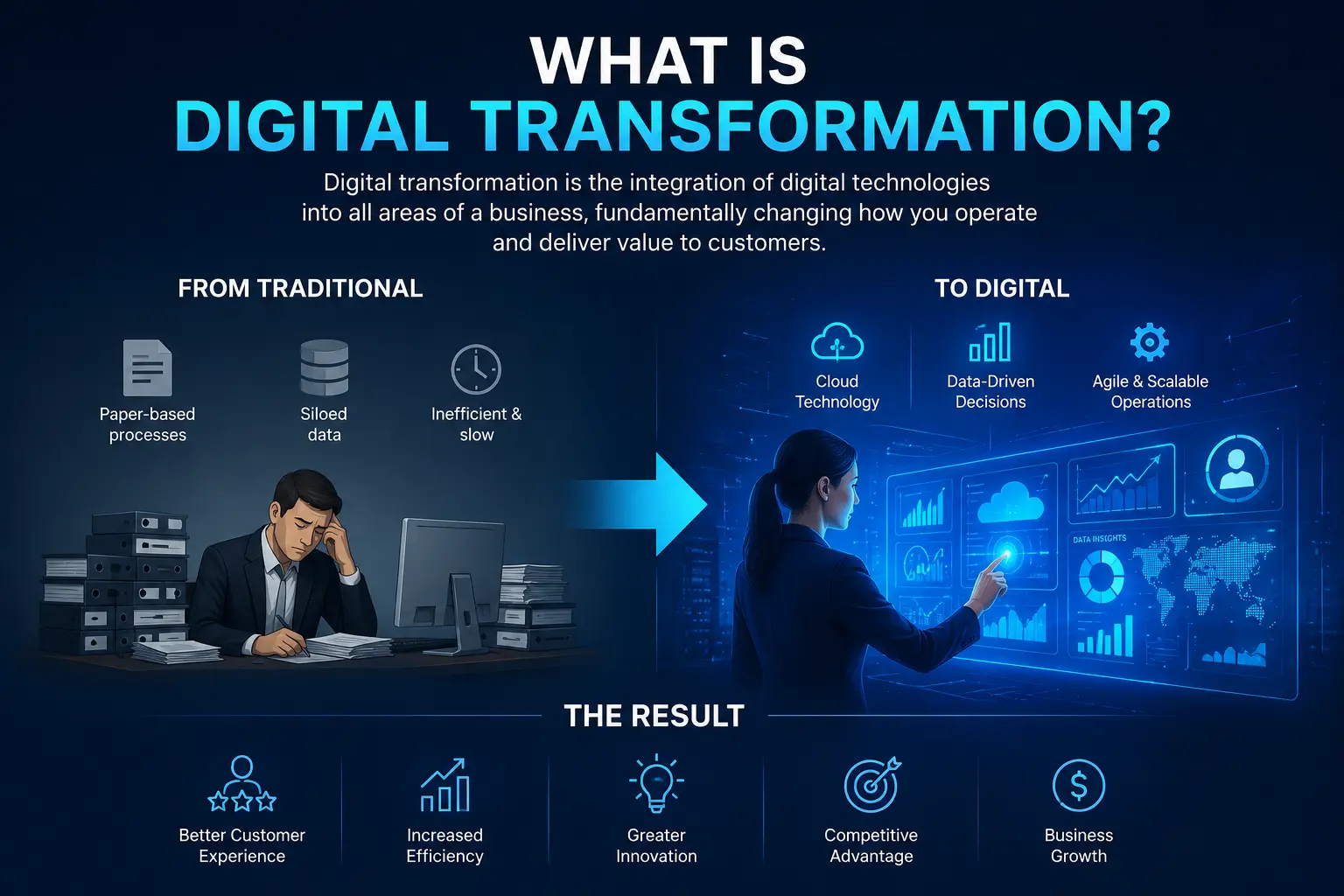
Digital transformation is the process of using digital technologies to improve business operations, customer experiences, products, and overall company performance.
It involves replacing traditional manual processes with smarter digital solutions that help businesses work faster and more efficiently.
Simple Definition of Digital Transformation
In simple words, digital transformation means using technology to solve business problems and improve the way a company operates.
This can include:
- Cloud computing
- Artificial intelligence (AI)
- Automation tools
- Data analytics
- Online platforms
- Digital communication systems
For example:
- Retail stores using online shopping platforms
- Banks offering mobile banking apps
- Hospitals storing patient records digitally
- Companies automating customer support with chatbots
Why Businesses Are Investing in Digital Transformation
Businesses are investing heavily in digital transformation because customer expectations and market competition are changing rapidly.
Main reasons include:
Better Customer Experience
Customers expect faster service, personalized recommendations, and smooth digital experiences.
Increased Efficiency
Automation reduces manual work and saves time.
Faster Decision-Making
Real-time data helps companies respond quickly to market changes.
Improved Productivity
Digital systems streamline operations and improve collaboration.
Staying Competitive
Businesses that fail to adapt digitally often lose customers to more innovative competitors.
What Are Data and Analytics?
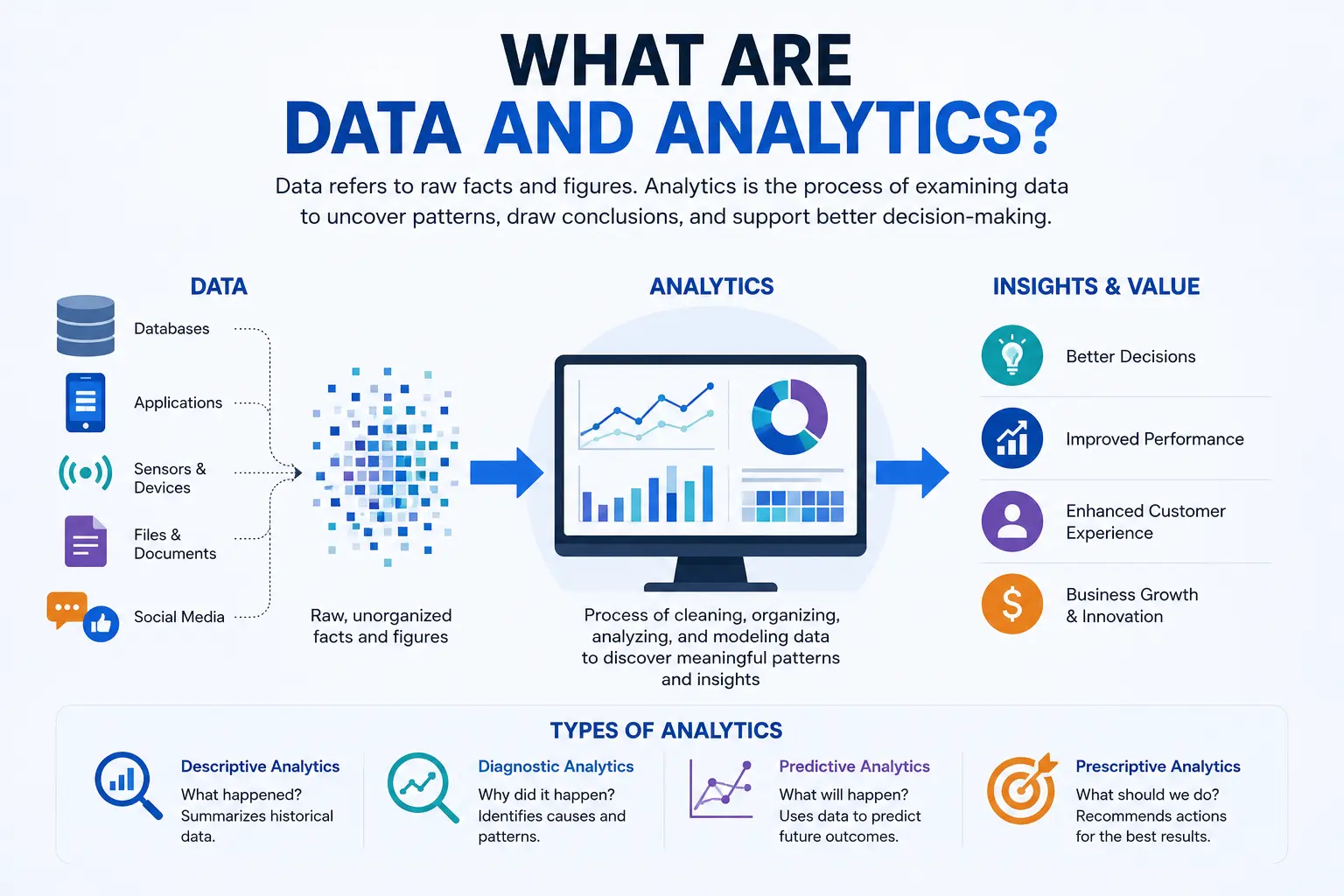
Data refers to raw information collected from different sources, while analytics means examining that data to discover useful insights.
Businesses collect data from:
- Websites
- Customer purchases
- Social media
- Mobile apps
- Emails
- Sales systems
- Sensors and smart devices
Analytics helps companies understand patterns, trends, and opportunities hidden within that information.
Understanding Business Data
Structured Data
Organized data stored in databases, spreadsheets, or CRM systems.
Examples:
- Customer names
- Sales reports
- Inventory records
Unstructured Data
Data that does not follow a fixed format.
Examples:
- Videos
- Emails
- Social media posts
- Images
Customer Data
Information related to customer behavior, preferences, and buying habits.
Operational Data
Data generated from business operations like production, logistics, and workflows.
What Business Analytics Means
Business analytics uses tools and technologies to analyze data and improve decision-making.
Descriptive Analytics
Shows what happened in the past.
Example:
Monthly sales reports.
Predictive Analytics
Predicts future outcomes using historical data.
Example:
Forecasting future customer demand.
Prescriptive Analytics
Suggests actions businesses should take.
Example:
Recommending marketing strategies.
Real-Time Analytics
Provides live insights instantly.
Example:
Monitoring website traffic in real time.
Difference Between Data and Analytics
| Data | Analytics |
|---|---|
| Raw information | Analysis of information |
| Unorganized facts | Useful business insights |
| Collected from systems | Used for decision-making |
| No direct value alone | Helps solve problems |
Why Data and Analytics Are Key to Digital Transformation
Data and analytics are the core drivers of successful digital transformation because they help businesses make smarter, faster, and more strategic decisions.
Better Business Decision-Making
Traditional business decisions were often based on assumptions or limited information. Today, analytics provides accurate insights backed by real data.
For example:
- Companies can identify which products sell the most.
- Marketing teams can measure campaign performance.
- Managers can track employee productivity.
This reduces guesswork and improves business outcomes.
Improved Customer Experience
Customer experience is one of the biggest reasons businesses invest in analytics.
By analyzing customer behavior, companies can:
- Personalize recommendations
- Improve customer service
- Understand buying habits
- Create targeted marketing campaigns
For example, e-commerce websites recommend products based on previous customer activity.
Faster Business Operations
Analytics helps businesses identify inefficiencies and optimize processes.
Benefits include:
- Faster workflows
- Reduced manual tasks
- Better resource management
- Improved operational efficiency
Automation powered by analytics allows businesses to complete tasks more quickly and accurately.
Increased Revenue Opportunities
Data analytics helps companies discover new growth opportunities.
Businesses can:
- Identify profitable customer segments
- Predict market trends
- Optimize pricing strategies
- Improve sales forecasting
This leads to higher revenue and better business planning.
Real-Time Insights for Faster Actions
Modern businesses need instant access to information.
Real-time analytics helps companies:
- Monitor performance live
- Detect problems immediately
- Respond quickly to customer needs
- Make fast operational decisions
For example:
A logistics company can track delivery performance in real time and solve delays instantly.
Supports Artificial Intelligence and Automation
Artificial intelligence relies heavily on quality data.
Without data, AI systems cannot:
- Learn patterns
- Predict outcomes
- Automate tasks effectively
Analytics provides the foundation for:
- Machine learning
- Smart automation
- AI-powered customer support
- Predictive systems
Enhances Competitive Advantage
Companies using analytics can adapt faster than competitors.
They can:
- Understand market changes quickly
- Launch products faster
- Improve customer satisfaction
- Innovate more effectively
Businesses that ignore data-driven strategies often struggle to compete in digital markets.
Benefits of Using Data Analytics in Digital Transformation
Improved Productivity
Automation and analytics reduce repetitive tasks and improve employee efficiency.
Reduced Operational Costs
Businesses can identify waste, optimize processes, and reduce unnecessary expenses.
Stronger Customer Retention
Analytics helps businesses understand customer needs and improve satisfaction.
Happy customers are more likely to stay loyal.
Better Risk Management
Businesses can detect fraud, security threats, and operational risks earlier through predictive analytics.
More Accurate Forecasting
Analytics improves forecasting for:
- Sales
- Inventory
- Demand
- Revenue
- Market trends
Smarter Marketing Strategies
Marketing teams use analytics to:
- Track campaign performance
- Understand audience behavior
- Improve conversions
- Increase ROI
Real-World Examples of Data-Driven Digital Transformation
Retail Industry
Retail companies use analytics for:
- Personalized shopping experiences
- Inventory management
- Customer recommendations
Example:
Online stores recommend products based on browsing history.
Healthcare Industry
Hospitals use analytics to:
- Improve patient care
- Analyze medical records
- Predict health risks
Banking and Finance
Banks use data analytics for:
- Fraud detection
- Risk management
- Customer behavior analysis
Manufacturing Industry
Manufacturers use analytics for:
- Predictive maintenance
- Supply chain optimization
- Smart factory systems
E-Commerce Platforms
E-commerce businesses rely heavily on analytics to:
- Increase sales
- Improve customer experience
- Track user behavior
- Optimize product recommendations
Key Technologies Behind Data-Driven Transformation
Big Data
Big data technologies help businesses process huge volumes of information quickly.
Artificial Intelligence (AI)
AI uses data to automate tasks and improve decision-making.
Machine Learning
Machine learning systems improve automatically using historical data.
Cloud Computing
Cloud platforms allow businesses to store and access data from anywhere.
Business Intelligence Tools
BI tools help visualize data through dashboards and reports.
Popular tools include:
Internet of Things (IoT)
IoT devices collect real-time data from connected systems and smart devices.
Common Challenges Businesses Face
Poor Data Quality
Incorrect or incomplete data can lead to poor decisions.
Data Security and Privacy Risks
Businesses must protect customer information and comply with data regulations.
Lack of Skilled Professionals
Many companies struggle to find experienced data analysts and engineers.
Integration Problems
Combining data from multiple systems can be difficult.
High Initial Investment
Digital transformation often requires investment in technology, training, and infrastructure.
How Businesses Can Successfully Use Data and Analytics
Define Clear Business Goals
Businesses should identify what they want to achieve before implementing analytics.
Collect Relevant Data
Focus only on valuable data that supports business objectives.
Use the Right Analytics Tools
Choose tools based on business size, goals, and budget.
Build a Data-Driven Culture
Encourage teams to use data in daily decision-making.
Train Employees Properly
Employees should understand how to interpret and use analytics effectively.
Continuously Monitor Performance
Businesses should regularly measure results and improve strategies over time.
Best Data Analytics Tools for Digital Transformation
Microsoft Power BI
Best for interactive dashboards and business reporting.
Tableau
Popular for advanced data visualization and analytics.
Google Analytics
Widely used for website and marketing analytics.
Apache Spark
Powerful platform for big data processing.
Snowflake
Cloud-based data platform for modern analytics.
Future Trends in Data and Digital Transformation
AI-Powered Analytics
AI will automate data analysis and improve predictions.
Real-Time Decision Intelligence
Businesses will increasingly rely on live analytics for faster decisions.
Predictive Business Models
Companies will use predictive analytics to anticipate customer behavior and market trends.
Edge Analytics
Data processing will move closer to devices and sensors for faster performance.
Hyperautomation
Businesses will combine AI, analytics, and automation to streamline operations completely.
Why Small Businesses Also Need Data Analytics
Data analytics is not only for large enterprises.
Small businesses can also benefit by:
- Understanding customer behavior
- Improving marketing strategies
- Increasing sales
- Reducing costs
- Competing more effectively
Affordable cloud-based analytics tools now make data-driven strategies accessible for smaller companies.
Frequently Asked Questions (FAQs)
Why are data and analytics important for digital transformation?
They help businesses make smarter decisions, improve efficiency, automate operations, and deliver better customer experiences.
How does analytics improve business performance?
Analytics identifies trends, measures performance, predicts outcomes, and helps businesses optimize strategies.
What industries benefit most from data analytics?
Industries like retail, healthcare, finance, manufacturing, logistics, and e-commerce benefit greatly from analytics.
What tools are used for digital transformation analytics?
Popular tools include Power BI, Tableau, Google Analytics, Snowflake, and Apache Spark.
Is data analytics necessary for small businesses?
Yes. Small businesses use analytics to understand customers, improve marketing, and make better business decisions.
What are the biggest challenges in digital transformation?
Common challenges include poor data quality, security risks, integration issues, and lack of skilled professionals.
Conclusion
Understanding why data and analytics are key to digital transformation is essential for businesses that want to grow in today’s digital economy. Data helps organizations make informed decisions, improve customer experiences, increase operational efficiency, and stay competitive in rapidly changing markets.
Businesses that successfully use analytics can adapt faster, innovate more effectively, and discover new growth opportunities. As technologies like artificial intelligence, machine learning, and automation continue to evolve, data analytics will become even more important for future business success.
Companies that invest in data-driven transformation today will be better prepared for tomorrow’s digital challenges and opportunities.